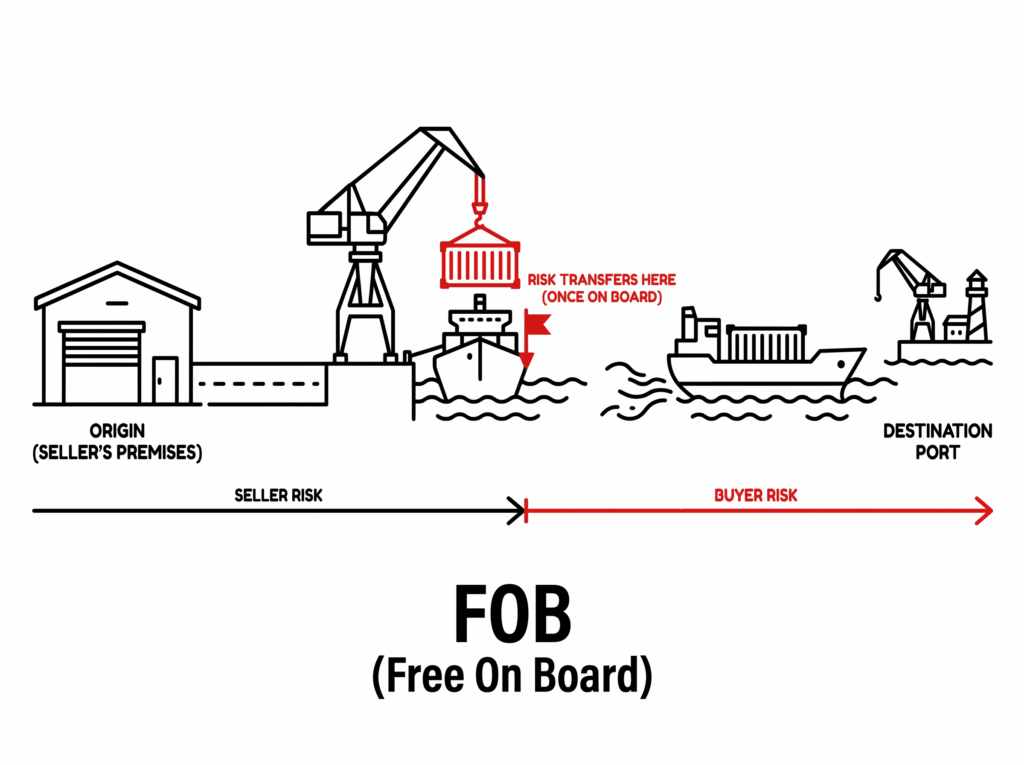
FOB, Free On Board, is an Incoterms 2020 rule used only for sea and inland waterway transport, where the seller delivers goods loaded on board a vessel at the named port of shipment, and risk transfers to the buyer at that point. FOB is also widely considered the most frequently misused Incoterm, because it keeps getting written into contracts for containerized cargo, which creates a real liability gap during the days a container often sits at a terminal before it is actually loaded.
What the FOB Incoterm actually requires
Under this rule, the seller clears the goods for export, delivers them to the port and bears risk and cost until the goods are loaded on board the vessel. Once loaded, risk transfers to the buyer, who then arranges and pays for the main sea freight, insurance, destination charges, and import clearance.
This rule was built for bulk and breakbulk cargo, oil, grain, ore and similar commodities, where the seller directly controls placing the goods on board.
The liability gap that makes this rule risky for containers
Container shipments do not load onto a vessel the moment they arrive at the port. A container is typically delivered to the terminal days before the ship arrives, sits in a stacking yard, and is loaded only when the vessel’s schedule allows.
- The seller no longer physically controls the container once it enters the terminal, even though this rule says risk does not transfer until the goods are on board.
- Damage or loss during that gap can leave both parties disputing who was responsible, since neither the seller nor the buyer was in direct control at the terminal.
- Insurance can be affected too, since a policy written around this rule’s risk transfer point may not clearly cover a loss that happens before loading.
The International Chamber of Commerce has long recommended FCA instead of FOB for exactly this reason, since FCA lets risk transfer at the actual handover point, such as the terminal, rather than at a loading event the seller cannot fully control.
FOB in the United States: two different meanings, one term
In the US, FOB has a second, unrelated meaning under the Uniform Commercial Code, where it governs domestic sales and can apply to any mode of transport, not just sea freight. Domestic FOB terms also address title transfer, which international FOB under the Incoterms rules does not address at all.
- Domestic FOB under the UCC can mean origin delivery or destination delivery, and covers ownership as well as risk.
- International FOB under the Incoterms rules only applies to sea and inland waterway transport, and addresses risk and cost, not ownership.
- The fix is simple but often skipped, stating the Incoterms version explicitly in the contract, for example “FOB Shanghai, Incoterms 2020,” removes the ambiguity entirely.
The practical fix: recognize misapplied FOB and route it through FCA instead
A forwarder who spots a container shipment quoted under this rule out of habit has a genuine opportunity to close the liability gap before it becomes a dispute. The fix is not a new Incoterm, it is the one already built for this exact case.
- FCA lets risk transfer at the terminal or another named place, matching where the seller’s control actually ends.
- FCA works for every mode of transport, including the onboard courier model this entire series has been built around, which this rule and FAS structurally cannot support.
- Correcting this to FCA on a container shipment is often a matter of updating the contract language, not renegotiating the underlying deal.
This is also where OBC ONE re-enters the picture. Once a shipment is properly routed under FCA rather than misapplied FOB, an onboard courier can serve as the named first carrier exactly as described in the FCA article in this series.
FOB vs. FAS vs. FCA
These three rules are frequently confused, and the wrong choice for the cargo type is the single most common Incoterms mistake in international trade.
| Criteria | FAS | FOB | FCA |
|---|---|---|---|
| Transport modes | Sea and inland waterway only | Sea and inland waterway only | Any mode, including air and courier |
| Delivery point | Alongside the vessel | Loaded on board the vessel | Named place, seller’s premises or a terminal |
| Best suited for | Bulk cargo loaded directly at the ship’s side | Bulk cargo the seller loads on board | Containerized cargo and any non-bulk shipment |
How OBC ONE supports the fix once this rule is corrected to FCA
A typical mission runs through six steps with OBC ONE once a shipment is properly routed, most of which overlap to save time.
- Brief and quote. You share the named place, the corrected Incoterm and the deadline. OBC ONE returns an all-in quote in under 15 minutes.
- Courier assignment. A vetted courier near the seller’s premises is dispatched to serve as the named first carrier.
- Coordinated handover. Collection happens directly from the seller, closing the liability gap that this rule would have left open.
- Personal custody in transit. The courier carries the shipment in the cabin, staying with it through every connection.
- Import coordination. Customs clearance at destination is handled alongside delivery.
- Proof of delivery. Timestamped confirmation for both parties’ records.
Why freight forwarders route corrected shipments through OBC ONE
Choosing the right partner for this kind of shipment starts with the business model. Many specialty couriers sell directly to shippers, which puts them in competition with the forwarders who might otherwise use them. OBC ONE is built the opposite way: we work exclusively for and with freight forwarders and time-critical desks. We never approach your clients directly and never compete with you.
That partner model is backed by real operator experience. OBC ONE was founded by an onboard courier who personally flew roughly three million kilometers over six years, so the network understands exactly where a misapplied term creates real risk. Forwarders use us because we deliver:
- An all-in quote in under 15 minutes, 24/7/365.
- 1,500+ vetted couriers positioned around major hubs worldwide, close to major factory and warehouse clusters.
- True door to door coverage, with import and export customs clearance and Importer of Record service in most markets.
- IATA certified dangerous goods capability for shipments that require it.
- One specialty, onboard courier and hand carry for time-critical missions, done at the highest standard.
How to spot a container shipment mistakenly quoted this way
- The cargo is containerized, whether full container load or less than container load, rather than bulk or breakbulk.
- No Incoterms version is specified, leaving domestic and international meanings genuinely ambiguous.
- The contract was copied from a previous deal without checking whether the cargo type actually matches this kind of shipment.
- The seller has no direct control over vessel loading, since the container will sit at a terminal for days before that happens.
- A forwarder-only partner who can flag this and route the corrected shipment through FCA instead, without competing for the underlying client relationship.
Frequently asked questions
What is the FOB Incoterm?
FOB, Free On Board, is an Incoterms 2020 rule used only for sea and inland waterway transport, where the seller delivers goods loaded on board a vessel at the named port, and risk transfers to the buyer at that point.
Why is this rule considered risky for containerized cargo?
Containers are typically delivered to the terminal days before the vessel loads, so the seller no longer physically controls the cargo even though the rule says risk does not transfer until loading. This creates a liability gap during that waiting period.
What is the difference between domestic FOB and international FOB?
Domestic FOB in the United States comes from the Uniform Commercial Code, applies to any mode of transport, and addresses ownership as well as risk. The international version under the Incoterms rules only applies to sea transport and addresses risk and cost, not ownership.
What should replace it for a container shipment?
FCA is the recommended alternative, since it allows risk to transfer at the actual handover point, such as a terminal, rather than at a loading event the seller often cannot control directly.
Can an onboard courier be used under FOB?
No. This rule applies only to bulk and breakbulk cargo loaded onto a vessel, which cannot travel by onboard courier. The connection to this series is the correction from misapplied FOB to FCA, which does support an onboard courier as the first carrier.
Do you sell directly to shippers or buyers?
No. OBC ONE works exclusively with and for freight forwarders and time-critical desks. We act as a white label partner and never approach our clients’ customers directly.
Get a quote for a corrected FCA shipment in 15 minutes
If you are a freight forwarder who has spotted a container shipment mistakenly quoted this way, OBC ONE can serve as the named first carrier once it is corrected to FCA, 24/7, worldwide and never a competitor. Contact our team for an all-in quote in under 15 minutes, or explore more time-critical logistics insights.