
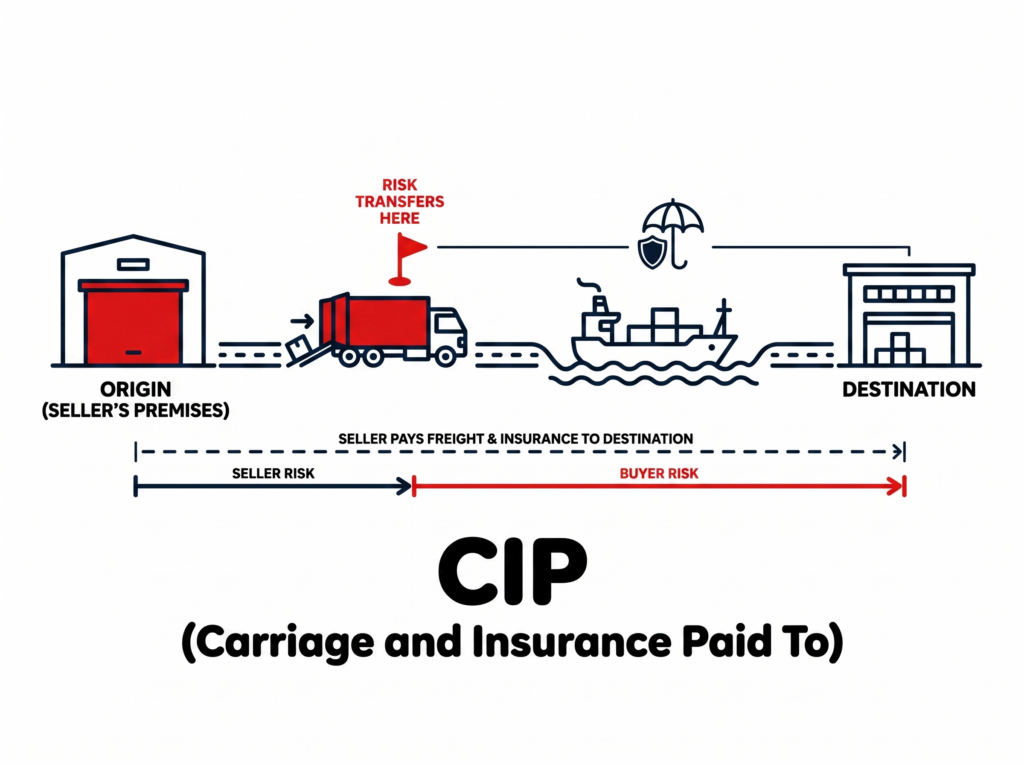
CIP, Carriage and Insurance Paid To, is the Incoterms 2020 rule under which the seller pays for both carriage to a named destination and cargo insurance covering the buyer’s risk, at the comprehensive Institute Cargo Clauses A level. Risk still transfers to the buyer at the first carrier, exactly as under CPT. The insurance protects the value of the goods if something goes wrong, but it does not cover delay, so a time-critical CIP shipment still needs a courier who keeps the schedule intact, not just a policy that pays out after it slips.
What the CIP Incoterm adds to CPT
CIP and CPT share an identical structure for delivery, cost and risk, as defined by the International Chamber of Commerce in the Incoterms 2020 rules: the seller pays carriage to the named destination, and risk transfers to the buyer at the first carrier, near origin. The only difference is that under the CIP Incoterm, the seller must also buy cargo insurance covering the buyer’s risk for that entire transit.
This single difference makes CIP the more common choice for higher value manufactured goods, where the buyer wants the seller to arrange comprehensive protection rather than sourcing separate cargo insurance themselves.
Institute Cargo Clauses A: what the CIP Incoterm changed under Incoterms 2020
Before Incoterms 2020, CIP only required the seller to buy minimum coverage under Institute Cargo Clauses C, the same level still required for CIF. Incoterms 2020 raised the bar specifically for CIP: the seller must now provide Institute Cargo Clauses A coverage, often called all risks cover, at a minimum of 110 percent of the invoice value.
- Institute Cargo Clauses A covers a broad range of physical loss or damage during transit, with specific named exclusions rather than a short list of covered perils.
- Institute Cargo Clauses C, the level still used for CIF, only covers a narrow set of named events, such as fire, stranding or general average, and leaves out risks like theft entirely.
- The upgrade to Clause A under CIP reflects that CIP is typically used for manufactured goods moving by air or multimodal transport, which carry different risks than the bulk commodities CIF was designed around.
These clauses are drafted by the Lloyd’s Market Association together with the International Underwriting Association, and are the market standard referenced directly in the Incoterms rules themselves.
What all risks insurance under the CIP Incoterm does not cover
Institute Cargo Clauses A is broad, but the name invites a common misunderstanding. It is not literally all risks.
- Delay is excluded, even when the delay is caused by an otherwise covered event. A policy that pays out for a damaged shipment still will not compensate for a missed production deadline or a blown service level agreement.
- Inherent vice and improper packing are excluded, meaning damage caused by the nature of the goods themselves or by inadequate packaging is not covered.
- War, strikes and willful misconduct require separate additional clauses, which the buyer can request but which are not automatically included.
For a time-critical CIP shipment, this gap matters more than the insurance itself. A successful claim compensates for the goods. It does nothing to recover the lost time, and for a shipment moving under deadline pressure, the lost time is often the larger cost.
Why an onboard courier still matters under the CIP Incoterm
CIP already gives the buyer comprehensive financial protection, which is more than CPT or FCA provide on their own. What it does not give the buyer is protection against the shipment simply arriving late, or against the operational disruption of sourcing a replacement while a claim is processed.
- Fewer handoffs mean fewer delays, and an onboard courier who keeps the shipment in personal custody removes several of the transfer points where a standard freight network typically loses time.
- Insurance settles a claim, not a deadline, so for a shipment where the delivery date matters as much as the value, minimizing the chance of an incident is worth more than a strong payout after one occurs.
- The named first carrier under CIP can be the courier directly, exactly as under CPT, giving the buyer both the insurance CIP requires and the reduced handling risk an onboard courier provides.
CIP Incoterm vs. CIF: a frequently confused pair
These two names look similar and are often mixed up, but they apply to different situations.
| Criteria | CIP | CIF |
|---|---|---|
| Transport modes | Any mode, including air and multimodal | Sea and inland waterway only |
| Risk transfer point | Handover to the first carrier | When goods are loaded onto the vessel |
| Required insurance level | Institute Cargo Clauses A, all risks | Institute Cargo Clauses C, minimum cover |
| Typical use case | Manufactured goods, containerized or air freight | Bulk commodities shipped by sea |
Using CIF for an air shipment, or CIP for bulk commodities, is a common contract drafting error worth catching before it causes a dispute.
How OBC ONE handles a CIP Incoterm first carrier handover
A typical CIP mission with OBC ONE runs through six steps, most of which overlap to save time.
- Brief and quote. You share the named delivery place, the named destination and the deadline. OBC ONE returns an all-in quote in under 15 minutes.
- Courier assignment. A vetted courier near the seller’s premises is dispatched to serve as the named first carrier.
- Coordinated handover. Collection happens directly from the seller at the agreed delivery point, marking the insured risk transfer clearly.
- Personal custody in transit. The courier carries the shipment in the cabin, staying with it through every connection, with no separate handoffs.
- Import coordination. Customs clearance at destination is handled alongside delivery.
- Proof of delivery. Timestamped confirmation and the transport documentation both parties need for their own records and for the insurer if it is ever needed.
Why freight forwarders route CIP missions through OBC ONE
Choosing the right partner for a CIP Incoterm first carrier handover starts with the business model. Many specialty couriers sell directly to shippers, which puts them in competition with the forwarders who might otherwise use them. OBC ONE is built the opposite way: we work exclusively for and with freight forwarders and time-critical desks. We never approach your clients directly and never compete with you.
That partner model is backed by real operator experience. OBC ONE was founded by an onboard courier who personally flew roughly three million kilometers over six years, so the network understands what a genuine first carrier handover requires. Forwarders use us because we deliver:
- An all-in quote in under 15 minutes, 24/7/365.
- 1,500+ vetted couriers positioned around major hubs worldwide, close to major factory and warehouse clusters.
- True door to door coverage, with import and export customs clearance and Importer of Record service in most markets.
- IATA certified dangerous goods capability for CIP shipments that require it.
- One specialty, onboard courier and hand carry for time-critical missions, done at the highest standard.
How to choose a first carrier for a CIP Incoterm shipment
- Genuine personal custody, not just a booking reference in a larger freight network.
- Real network density near major manufacturing and export hubs, so the courier can serve as the named first carrier without delay.
- Fast, transparent quoting, ideally with a named dispatcher accountable for the mission.
- Documented dangerous goods competence, where relevant to the specific shipment.
- A forwarder-only model, if you are a forwarder, so your first carrier partner never becomes a competitor for your clients.
Frequently asked questions
What is the CIP Incoterm?
CIP, Carriage and Insurance Paid To, is an Incoterms 2020 rule under which the seller pays for carriage to a named destination and buys cargo insurance covering the buyer’s risk, at the comprehensive Institute Cargo Clauses A level. Risk transfers to the buyer at the first carrier, near origin.
What is the difference between CIP and CPT?
CIP and CPT are structurally identical for delivery, cost and risk transfer. The only difference is that under CIP, the seller must also buy comprehensive cargo insurance covering the buyer’s risk, while under CPT the buyer must arrange their own insurance if they want coverage.
Does all risks insurance under CIP really cover everything?
No. Institute Cargo Clauses A excludes delay, inherent vice, improper packing, and war or strikes unless separately added. A successful claim compensates for the value of damaged or lost goods, but it does not compensate for a missed deadline.
What is the difference between CIP and CIF?
CIP works for any mode of transport and requires Institute Cargo Clauses A coverage. CIF is used only for sea and inland waterway transport and requires the lower Institute Cargo Clauses C coverage. The two are often confused but apply to different shipment types.
Why use an onboard courier if CIP already includes insurance?
Insurance under CIP protects the financial value of the goods but does not cover delay or the operational disruption of a claim. An onboard courier reduces the number of handoffs in transit, lowering the chance of an incident in the first place and protecting the delivery schedule that insurance alone cannot.
Do you sell directly to shippers or buyers?
No. OBC ONE works exclusively with and for freight forwarders and time-critical desks. We act as a white label partner and never approach our clients’ customers directly.
Get a CIP Incoterm first carrier quote in 15 minutes
If you are a freight forwarder structuring a CIP shipment, OBC ONE can serve as the named first carrier, 24/7, worldwide and never a competitor. Contact our team for an all-in quote in under 15 minutes, or explore more time-critical logistics insights.