
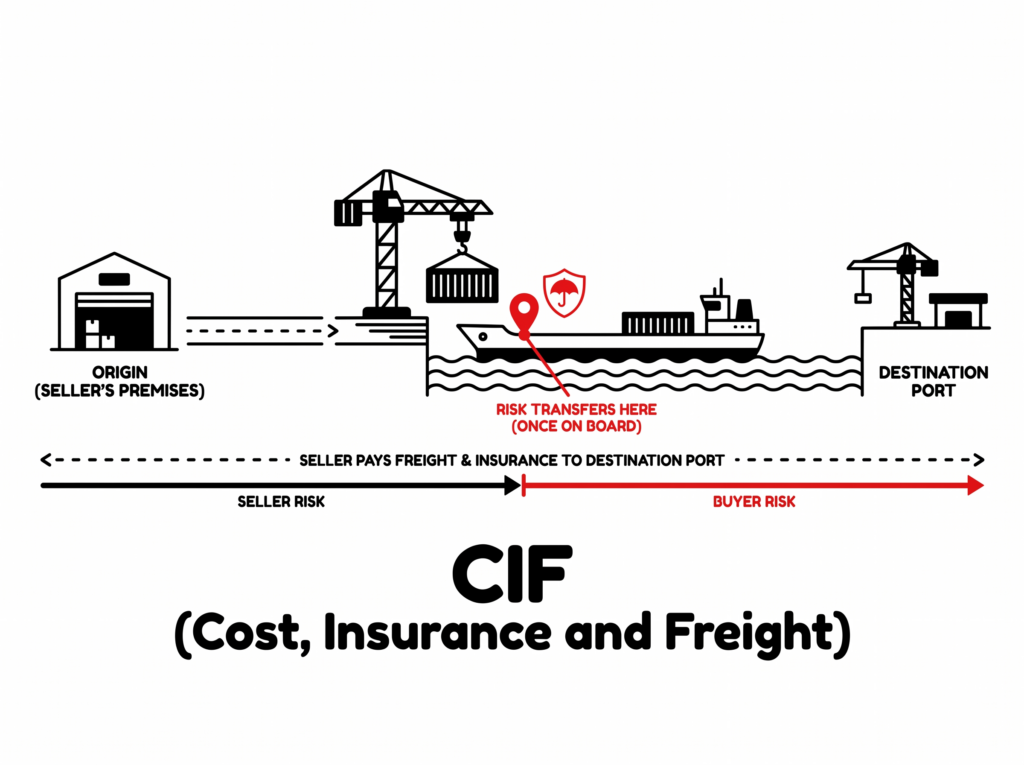
CIF, Cost, Insurance and Freight, is an Incoterms 2020 rule used only for sea and inland waterway transport, where the seller pays freight and buys cargo insurance to the named destination port, but risk still transfers to the buyer earlier, when the goods are loaded on board the vessel at origin. Buyers frequently assume CIF gives them the same protection as CIP, already covered in this series, but CIF only requires the weaker Institute Cargo Clauses C minimum cover, not the all risks level CIP demands.
CIF is CIP’s sea only sibling, with weaker insurance
Structurally, this rule is identical to CFR with one addition: the seller must also buy cargo insurance covering the buyer’s risk for the voyage. This mirrors how CIP relates to CPT, the seller pays and insures, while risk still transfers earlier than the seller’s payment obligation suggests it might.
The difference that catches buyers out is the insurance level. Under CIP, Incoterms 2020 requires the seller to buy Institute Cargo Clauses A, an all risks policy. Under CIF, the requirement remains the lower Institute Cargo Clauses C, a minimum cover policy defined by the Lloyd’s Market Association that only pays out for a narrow list of named events, such as fire, stranding, or general average, and excludes theft, pilferage, and most water damage entirely.
Why buyers assume more coverage than CIF actually provides
A buyer hearing that the seller has arranged insurance often assumes broad protection. Under this rule, that assumption is frequently wrong.
- Institute Cargo Clauses C covers major casualty events but leaves out common causes of cargo damage, including theft and general water ingress.
- Buyers can request higher coverage, typically Clauses A, but this has to be negotiated and paid for separately, since the seller’s default obligation stops at the minimum level.
- Filing a claim under a minimum cover policy can mean discovering, only after a loss, that the specific cause of damage was never covered in the first place.
The same container problem as FOB and CFR
This rule shares the identical risk transfer point with FOB and CFR: the moment goods are loaded on board the vessel. Containers are typically delivered to a terminal days before that loading actually happens, creating the same gap already explained in both of those articles.
- The seller has no physical control over a container sitting in a terminal stacking yard, even though risk under this rule has not yet transferred.
- Damage during that waiting period falls into the same disputed territory as under FOB and CFR, regardless of the insurance this rule requires.
- The International Chamber of Commerce recommends CIP instead for containerized cargo, for exactly the same reason it recommends CPT over CFR and FCA over FOB.
CIF vs. CFR vs. CIP
These three rules form a closely related family, and the differences come down to mode and insurance level.
| Criteria | CFR | CIF | CIP |
|---|---|---|---|
| Transport modes | Sea and inland waterway only | Sea and inland waterway only | Any mode, including air and courier |
| Seller buys insurance | No | Yes, minimum cover | Yes, all risks cover |
| Insurance standard | Not applicable | Institute Cargo Clauses C | Institute Cargo Clauses A |
| Risk transfer point | Loaded on board | Loaded on board, same as CFR | Handover to the first carrier |
The insurance gap between CIF and CIP is the detail most often missed in practice, since both names sound like they offer comparable protection.
Why bulk cargo under CIF is not an onboard courier fit
This rule exists for the same category of cargo already covered honestly in the FAS article, bulk and breakbulk commodities loaded directly onto a vessel. None of that cargo will ever travel by onboard courier.
The genuine connection is the one already established for FOB and CFR: once a container shipment mistakenly quoted this way is corrected to CIP, an onboard courier can serve as the named first carrier, exactly as described in the CIP article in this series.
How OBC ONE supports a shipment once it is corrected to CIP
A typical mission runs through six steps with OBC ONE once a shipment is properly routed, most of which overlap to save time.
- Brief and quote. You share the named place, the corrected Incoterm and the deadline. OBC ONE returns an all-in quote in under 15 minutes.
- Courier assignment. A vetted courier near the seller’s premises is dispatched to serve as the named first carrier.
- Coordinated handover. Collection happens directly from the seller, closing the gap a container waiting at a terminal would otherwise create.
- Personal custody in transit. The courier carries the shipment in the cabin, staying with it through every connection.
- Import coordination. Customs clearance at destination is handled alongside delivery.
- Proof of delivery. Timestamped confirmation for both parties’ records.
Why freight forwarders route corrected shipments through OBC ONE
Choosing the right partner for this kind of shipment starts with the business model. Many specialty couriers sell directly to shippers, which puts them in competition with the forwarders who might otherwise use them. OBC ONE is built the opposite way: we work exclusively for and with freight forwarders and time-critical desks. We never approach your clients directly and never compete with you.
That partner model is backed by real operator experience. OBC ONE was founded by an onboard courier who personally flew roughly three million kilometers over six years, so the network understands exactly where a misapplied sea only term creates real risk. Forwarders use us because we deliver:
- An all-in quote in under 15 minutes, 24/7/365.
- 1,500+ vetted couriers positioned around major hubs worldwide, close to major factory and warehouse clusters.
- True door to door coverage, with import and export customs clearance and Importer of Record service in most markets.
- IATA certified dangerous goods capability for shipments that require it.
- One specialty, onboard courier and hand carry for time-critical missions, done at the highest standard.
How to spot a container shipment mistakenly quoted CIF
- The cargo is containerized, rather than bulk or breakbulk loaded directly at the ship’s side.
- The buyer assumed this rule meant comprehensive coverage, when the seller’s obligation only extends to Institute Cargo Clauses C.
- No additional insurance was negotiated, leaving common causes of loss, such as theft, genuinely uncovered.
- The contract was copied from a previous deal without checking whether the cargo type still matches a vessel loaded shipment.
- A forwarder-only partner who can flag this and route the corrected shipment through CIP instead, without competing for the underlying client relationship.
Frequently asked questions
What is the CIF Incoterm?
CIF, Cost, Insurance and Freight, is an Incoterms 2020 rule used only for sea and inland waterway transport, where the seller pays freight and buys minimum cargo insurance to the named destination port, but risk transfers earlier, at loading.
What is the difference between CIF and CIP?
CIF only requires Institute Cargo Clauses C, a minimum cover policy with narrow named exclusions. CIP requires the broader Institute Cargo Clauses A, an all risks policy. CIF is also restricted to sea transport, while CIP works for any mode.
What is the difference between CIF and CFR?
The two rules share the same risk transfer point and freight payment structure. The only difference is insurance: CIF requires the seller to buy minimum cargo insurance, while CFR does not require any.
Why is CIF risky for containerized cargo?
Containers typically wait at a terminal for days before loading, during which the seller has no physical control over the cargo even though risk technically has not transferred yet, the same problem already described for FOB and CFR.
What should replace CIF for a container shipment?
CIP is the recommended alternative, since it provides broader insurance and lets risk transfer at the actual handover point rather than at a vessel loading event the seller often cannot fully control.
Do you sell directly to shippers or buyers?
No. OBC ONE works exclusively with and for freight forwarders and time-critical desks. We act as a white label partner and never approach our clients’ customers directly.
Get a quote for a corrected CIP shipment in 15 minutes
If you are a freight forwarder who has spotted a container shipment mistakenly quoted this way, OBC ONE can serve as the named first carrier once it is corrected to CIP, 24/7, worldwide and never a competitor. Contact our team for an all-in quote in under 15 minutes, or explore more time-critical logistics insights.