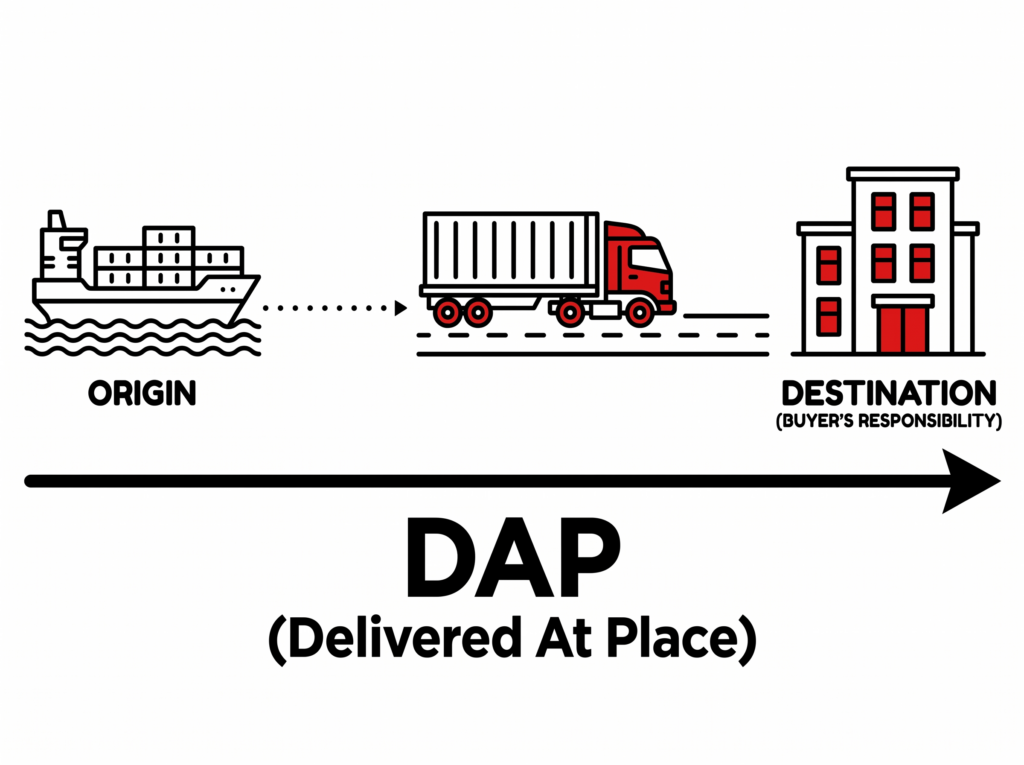
DAP, Delivered At Place, is the Incoterms 2020 rule under which the seller bears the cost and risk of the entire journey to a named destination, delivering the goods ready for unloading, not unloaded. The buyer only takes over at that point, handling unloading, import clearance, and duties. This is the opposite risk profile from EXW, FCA, CPT, and CIP, where the buyer carries risk early. Under the DAP Incoterm, it is the seller whose money is on the line for the whole trip, which makes the seller the one who benefits most from a courier who keeps the shipment in personal custody all the way.
Why the DAP Incoterm flips the risk picture
EXW, FCA, CPT and CIP all transfer risk to the buyer at some point near the origin, whether that is the seller’s own premises, a named place, or the first carrier. Under the DAP Incoterm, none of that applies. The seller bears the cost and risk of the entire journey, and delivery only happens when the goods reach the named destination, ready for unloading.
This means the party with the most at stake during transit is the seller, not the buyer. For freight forwarders, this changes the conversation: it is usually the seller’s side asking how to protect a shipment they remain financially responsible for until it lands on the buyer’s doorstep.
What the DAP Incoterm actually requires
- The seller arranges and pays for transport to the named destination, clears export formalities and bears all risk of loss or damage until the goods arrive ready for unloading.
- The buyer unloads the goods, handles import customs clearance and pays any duties, taxes and inspection fees at destination.
- Insurance is not required under the DAP Incoterm for either party, though sellers carrying this much risk commonly arrange it anyway.
The named destination should be as specific as possible, since it defines exactly where the seller’s risk ends and the buyer’s obligations begin.
DAP vs. DPU: who unloads matters
DAP and DPU are nearly identical, with one deliberate difference.
- Under this rule, the seller delivers the goods at the named destination not unloaded, ready for the buyer to unload.
- Under DPU, the only Incoterms rule that requires it, the seller must unload the goods at the named destination before risk transfers to the buyer.
DPU makes sense when the seller has the equipment or relationship to handle unloading, such as specialized machinery being installed on site. For most shipments, this arrangement keeps that responsibility, and its risk, with the buyer instead.
DAP vs. DDP: who handles import duties matters more
DAP and DDP share the same delivery point and the same risk transfer timing. The difference that actually matters is import clearance.
- Under this rule, the buyer clears customs, pays duties and taxes and deals with any import complications at destination.
- Under DDP, the seller takes on import clearance and duties as well, which several trade finance sources actively warn sellers against, since unfamiliar customs regimes and unpredictable duty rates in a foreign country create real financial exposure.
Many sellers prefer this Incoterm specifically because it keeps control over transport while avoiding the unpredictable duty and customs risk that comes with DDP. The International Trade Administration publishes further guidance for exporters weighing this choice.
Why the seller needs the onboard courier
Since the seller bears risk for the entire journey under this rule, a lost or damaged shipment is the seller’s financial problem, not the buyer’s, all the way until it reaches the named destination. This is exactly the reverse of the buyer-side urgency that applies under EXW, FCA, CPT, and CIP.
- Fewer handoffs mean fewer chances for something to go wrong during the exact period the seller, not the buyer, is financially exposed.
- A single accountable courier gives the seller’s forwarder a direct line of visibility into a shipment they remain responsible for the whole way.
- An onboard courier can carry the shipment personally to the named destination, closing out the seller’s risk exposure as cleanly and quickly as possible.
DAP vs. FCA vs. CPT vs. DPU vs. DDP
A quick reference for where it sits among the Incoterms covered in this series and its closest D-group neighbors.
| Criteria | FCA / CPT | DAP | DPU | DDP |
|---|---|---|---|---|
| Risk transfers to buyer | Near origin, at first carrier | At destination, ready for unloading | At destination, after unloading | At destination, ready for unloading |
| Who unloads | Buyer | Buyer | Seller | Buyer |
| Who clears import customs | Buyer | Buyer | Buyer | Seller |
| Highest exposure for | Buyer, from an early point | Seller, for the full journey | Seller, plus unloading | Seller, plus duties and taxes |
How OBC ONE handles a DAP delivery
A typical mission under this Incoterm runs through six steps with OBC ONE, most of which overlap to save time.
- Brief and quote. You share the origin, the named destination and the deadline. OBC ONE returns an all-in quote in under 15 minutes.
- Courier assignment. A vetted courier near the seller’s premises is dispatched to carry the shipment personally.
- Secure pickup. Collection happens directly from the seller, starting the seller’s risk clock under a single accountable custody chain.
- Personal custody in transit. The courier carries the shipment in the cabin, staying with it through every connection, with no separate handoffs.
- Arrival ready for unloading. The shipment reaches the named destination, where the buyer takes over as this Incoterm specifies.
- Proof of delivery. Timestamped confirmation closing out the seller’s risk exposure with a clear record.
Why freight forwarders route DAP shipments through OBC ONE
Choosing the right partner for this kind of shipment starts with the business model. Many specialty couriers sell directly to shippers, which puts them in competition with the forwarders who might otherwise use them. OBC ONE is built the opposite way: we work exclusively for and with freight forwarders and time-critical desks. We never approach your clients directly and never compete with you.
That partner model is backed by real operator experience. OBC ONE was founded by an onboard courier who personally flew roughly three million kilometers over six years, so the network understands what a genuinely full journey risk requires. Forwarders use us because we deliver:
- An all-in quote in under 15 minutes, 24/7/365.
- 1,500+ vetted couriers positioned around major hubs worldwide, close to major factory and warehouse clusters.
- True door to door coverage, with import and export customs clearance and Importer of Record service in most markets.
- IATA certified dangerous goods capability for shipments under this Incoterm that require it.
- One specialty, onboard courier and hand carry for time-critical missions, done at the highest standard.
How to choose a courier for this kind of shipment
- Genuine personal custody, not just a booking reference in a larger freight network.
- Real network density near major manufacturing and export hubs, so the courier can begin the seller’s protected chain of custody without delay.
- Fast, transparent quoting, ideally with a named dispatcher accountable for the mission.
- Documented dangerous goods competence, where relevant to the specific shipment.
- A forwarder-only model, if you are a forwarder, so your delivery partner never becomes a competitor for your clients.
Frequently asked questions
What is the DAP Incoterm?
DAP, Delivered At Place, is an Incoterms 2020 rule under which the seller bears the cost and risk of the entire journey to a named destination, delivering the goods ready for unloading. The buyer handles unloading, import clearance, and duties from that point.
What is the difference between DAP and DPU?
Under DAP, the seller delivers the goods not unloaded, ready for the buyer to unload. Under DPU, the seller must unload the goods at the named destination before risk transfers to the buyer, the only Incoterms rule that requires this.
What is the difference between DAP and DDP?
DAP and DDP share the same delivery point and risk transfer timing. The buyer handles import clearance and duties under this term. Under DDP, the seller takes on that responsibility as well, which exposes the seller to unfamiliar foreign customs and duty risk.
Why does the seller carry more risk under the DAP Incoterm than under FCA or CPT?
Under FCA and CPT, risk transfers to the buyer near the point of origin. Under the DAP Incoterm, risk stays with the seller for the entire journey and only transfers once the goods reach the named destination, ready for unloading.
Why would a seller use an onboard courier under DAP?
Since the seller bears the full journey’s risk under this arrangement, a lost or damaged shipment is the seller’s financial problem until delivery. An onboard courier reduces the number of handoffs in transit, lowering the seller’s exposure during the exact period they remain responsible.
Do you sell directly to shippers or buyers?
No. OBC ONE works exclusively with and for freight forwarders and time-critical desks. We act as a white label partner and never approach our clients’ customers directly.
Get a delivery quote in 15 minutes
If you are a freight forwarder structuring a shipment under this Incoterm, OBC ONE can carry it personally to the named destination, 24/7, worldwide and never a competitor. Contact our team for an all-in quote in under 15 minutes, or explore more time-critical logistics insights.