
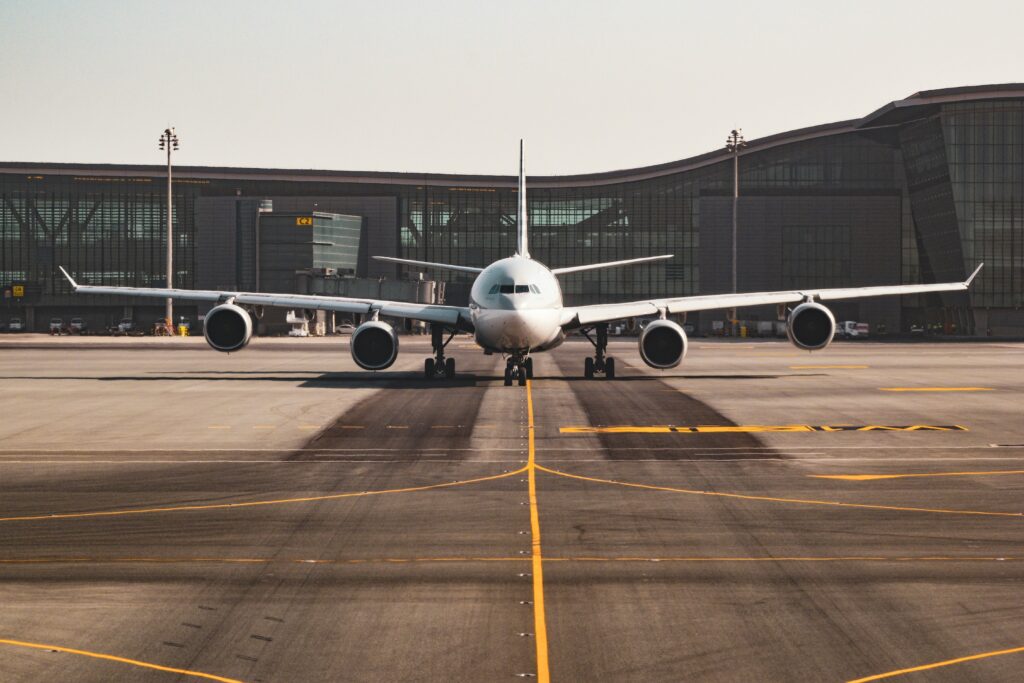
Aircraft on ground (AOG) is aviation's code for a grounded aircraft that cannot fly until a technical issue, usually a missing or failed part, is resolved. Every hour the aircraft stays grounded costs the operator between $10,000 and $150,000 in lost revenue, crew disruption and passenger compensation. That is why AOG triggers the fastest logistics protocols in the industry.
What "aircraft on ground" really means
Aircraft on ground, almost always shortened to AOG, is the urgent-service tag the aviation industry uses for any aircraft that has been declared unfit to fly until a specific defect is fixed. The phrase originally described the aircraft's status, but in everyday operations it has become a label. It gets stamped on spare parts, documents and shipments to tell everyone in the supply chain to drop other priorities and move this one to the front of the queue.
A flickering cabin light is not AOG. A failed hydraulic actuator, a faulty avionics LRU or a damaged landing gear component is. Once a Minimum Equipment List (MEL) deferral expires or a critical system goes out of tolerance, the aircraft sits, and the operational clock starts.
For freight forwarders with aviation, MRO or OEM clients, an aircraft on ground call is the moment the relationship is tested. Speed, custody and customs all have to work together, and the partner you pick on the next call is the one who either rescues the mission or extends the grounding.
What an aircraft on ground event actually costs
The numbers are the reason AOG dictates its own logistics rules.
The hourly cost benchmark
- A grounded narrowbody costs an operator $10,000 to $150,000 per hour in lost revenue, crew disruption and passenger compensation (IATA 2025).
- A widebody on a long haul route can run higher still.
- Industry-wide, flight disruptions (of which aircraft on ground events are a major share) cost airlines roughly $60 billion per year, about 8% of total revenue.
- The US average is around 14 AOG events per aircraft per year.
The hidden cascade costs
The direct hourly figure is only the start. A grounded aircraft also triggers:
- Passenger compensation under EU261/2004 and equivalent regimes, up to €600 per passenger for long delays.
- Slot violations at coordinated airports, with slots that may not be recoverable in the same season.
- Crew duty hour breaches requiring positioning, hotac and standby crew.
- Network knock-on: the aircraft that should have flown the Frankfurt to Madrid to Lisbon to Frankfurt rotation drags three more rotations into delay.
- Wet-lease exposure if the aircraft stays down for more than 24 hours.
This is why a logistics decision that costs €40,000 today can save half a million tomorrow. The price tag on the freight is never the right anchor. The cost of the delay is.
What causes an aircraft on ground situation?
Aircraft on ground events fall into a few recurring categories:
- Unplanned component failure: a hydraulic pump, actuator, sensor or avionics LRU fails in service.
- Findings during scheduled checks: A-Checks, B-Checks or routine inspections uncover a defect that cannot be deferred.
- Stock-out of critical spares: the part exists in the network, but not at this station. Sourcing turns a technical problem into a logistics problem.
- Documentation errors: wrong part or serial number, missing EASA Form 1 or FAA 8130-3, incomplete export paperwork.
- Environmental and wear factors: heat, salt air, high cycle routes that accelerate component fatigue.
- Dangerous goods misclassification: lithium battery packs, oxygen generators or chemicals declared incorrectly, triggering re-screen and hold.
Most of these compound. A failed LRU is a maintenance problem; an LRU that exists in Frankfurt while the aircraft sits in Manchester at 22:00 local time is a logistics problem with a fixed solution set.
How aircraft on ground logistics works
AOG logistics is the specialized discipline of moving the right aviation part, with the right paperwork, on the fastest workable route. Success is measured in a single KPI: time to wing. This is the elapsed time from the aircraft on ground declaration to the part being installed and signed off.
The aircraft on ground response timeline
- Trigger. Maintenance Control declares AOG and identifies the part by P/N and S/N.
- Sourcing. Procurement locates the part (in own inventory, at a sister station, with an OEM or in the secondary market) and confirms certification (EASA Form 1, FAA 8130-3).
- Logistics quote. The forwarder's AOG desk briefs a specialist partner and gets an all-in quote. At OBC ONE that quote comes back in under 15 minutes.
- Mode selection. The right transport mode is chosen based on time pressure, value, weight and customs complexity (see decision matrix below).
- Execution. Pickup, airline acceptance, customs pre alert, in flight custody, destination clearance and door to wing handoff.
- Sign off. The part is installed, the Certificate of Release to Service is signed and the aircraft is back in revenue service.
In a well run AOG mission, all six steps overlap. Customs is being pre cleared while the courier is in the cabin; the hangar slot is being booked while the part is still landside at the origin. The job of a real aircraft on ground partner is to compress this timeline, not to walk through it sequentially.
Onboard courier (OBC): for high value, custody critical parts
An onboard courier hand carries the part in the cabin of a commercial flight, maintaining personal custody from pickup to door to door delivery. It is the fastest scheduled airline option and the right call when the part is high value, fragile, or requires faster than cargo customs clearance. Typical intercontinental door to wing: 24 to 36 hours.
Next Flight Out (NFO): for speed driven parts that can travel as cargo
NFO books the shipment as expedited air cargo on the next available departure. There is no courier in the cabin and the part enters the airline's cargo system. NFO is meaningfully cheaper than OBC and works well when raw speed matters but the cargo can safely tolerate standard handling.
Dedicated air charter: for outsize, heavy or engine moves
When a complete engine, a landing gear assembly or oversized control surfaces have to move, charter is often the only viable option. Costs are highest, but a nonstop tail with door to airfield routing can deliver in 6 to 14 hours globally, with customs pre cleared in parallel.
Dedicated road: for short, time-sensitive distances
Within Europe or a single country, a dedicated vehicle (often paired with an OBC handoff) can beat air on point to point routes under roughly 800 km, especially when airline cutoffs would force a 24 hour slip.
Aircraft on ground logistics decision matrix
The right mode is the one that minimizes time to wing given the part's weight, value and customs profile. Use this as a fast triage tool.
| Mode | Typical time to wing | Indicative cost (intercontinental) | Best for | Watch out for |
|---|---|---|---|---|
| Onboard Courier (OBC) | 24 to 36 h | $5k to $30k | High value LRUs, avionics, fragile parts needing custody | Cabin / accompanied baggage size limits |
| Next Flight Out (NFO) | 24 to 48 h | $15 to $50 per kg + premiums | Speed driven parts that tolerate standard cargo handling | Cut-off times, cargo backlog, manual screening |
| Dedicated air charter | 6 to 14 h door to wing | €40k to €150k+ | Engines, landing gear, outsize or multi unit shipments | Slots, permits, aircraft positioning |
| Dedicated road | 4 to 12 h (intra-region) | €3 to €8/km + driver | Short distances, heavy parts, when airline cutoffs would slip a day | Border controls, drive-hour limits |
Dangerous goods in aircraft on ground shipments
A surprising share of AOG parts are dangerous goods (DG) or contain them. Examples include lithium battery packs in avionics, hydraulic fluid residue, oxygen generators, pyrotechnic squibs and chemical preservatives. Move one of these without proper IATA Dangerous Goods Regulations handling and the part gets refused at airline acceptance, re-screened or in the worst case confiscated. A 30 minute classification error can cost a 24 hour slip.
This is where most generalist forwarders quietly decline aircraft on ground missions. OBC ONE built dedicated IATA certified Dangerous Goods training specifically for onboard courier brokers (an industry first) so DG-classified parts move legally and on time instead of being quietly handed back. For more on classification, see the IATA Dangerous Goods Regulations.
Why freight forwarders run their AOG missions through OBC ONE
Most "AOG providers" sell directly to airlines, MROs and OEMs, which means they sell to your customers. OBC ONE is built the opposite way: we work exclusively for and with freight forwarders and time-critical desks. We never approach your clients, never compete with you and operate as a white label extension of your aircraft on ground desk.
That partner model is backed by real operator experience. OBC ONE was founded by an onboard courier who personally flew roughly three million kilometers over six years, so the network understands aircraft on ground missions from the cabin seat, not the spreadsheet. Forwarders use us because we deliver:
- An all in AOG quote in under 15 minutes, 24/7/365.
- 1,500+ vetted couriers positioned around major hubs worldwide.
- True door to wing coverage, with import/export customs clearance and Importer of Record service in most markets.
- IATA certified Dangerous Goods capability built for OBC brokers.
- One specialty (onboard courier and hand carry for time-critical missions) done at the highest standard.
How to choose an aircraft on ground logistics partner
Before the next AOG call lands on your desk, pressure-test your provider against these criteria:
- Real network density: couriers and operators near major airports, not someone who has to be flown in before they can fly your part out.
- Customs and IOR expertise on both origin and destination sides, with experience on aviation specific regimes (End Use, Inward / Outward Processing, AEO).
- Documented DG competence: IATA training certificates, not vague reassurance.
- Response time: a real all-in quote in minutes, with a named dispatcher accountable for the mission.
- A forwarder only model if you are a forwarder, so your partner never becomes your competitor.
- Multi-mode capability: OBC, NFO, charter and road under one accountable plan, not just whatever the provider happens to sell.
Frequently asked questions
What does AOG stand for?
AOG stands for aircraft on ground. It is the aviation industry's tag for an aircraft that cannot fly until a specific technical issue is fixed and it is also used to mark spare parts and shipments needed to resolve that grounding as top priority.
How much does an aircraft on ground situation cost per hour?
According to IATA 2025 data, a grounded narrowbody costs an operator between $10,000 and $150,000 per hour in lost revenue, crew disruption and passenger compensation. Widebodies on long haul routes can cost more. The headline number excludes cascade effects such as EU261 compensation, slot loss and wet lease exposure.
What is AOG logistics?
Aircraft on ground logistics is the specialized discipline of moving aviation spare parts, tools and personnel to a grounded aircraft on the fastest workable route. It combines onboard courier, next flight out, dedicated charter and dedicated road, plus customs and dangerous goods handling, into a single accountable plan measured by time to wing.
How fast can an aircraft on ground part be delivered?
With dedicated air charter, door to wing of 6 to 14 hours globally is realistic. With an onboard courier on a commercial flight, intercontinental missions typically land in 24 to 36 hours. Within Europe or a single country, dedicated road combined with an OBC handoff can hit 6 to 8 hours total.
What parts cause aircraft on ground events most often?
The most common AOG parts are Line Replaceable Units (LRUs), such as avionics modules, hydraulic actuators and fuel and pneumatic valves. These are followed by APU components, landing gear assemblies and flight control surfaces. Engines and major rotables are less frequent but the most expensive to move.
What is the difference between OBC and NFO for AOG?
An onboard courier (OBC) personally accompanies the part in the cabin, maintaining unbroken custody and faster customs clearance. Next Flight Out (NFO) books the part as expedited cargo on the next available flight, with no courier in the cabin. OBC offers the highest custody and clearance speed; NFO is meaningfully cheaper but slower at destination.
Do you sell directly to airlines or MROs?
No. OBC ONE works exclusively with and for freight forwarders and time-critical desks. We act as a white label partner and never approach our clients' customers.
Get an aircraft on ground quote in 15 minutes
If you are a freight forwarder with an aircraft on ground mission on the desk, OBC ONE is your specialist hand carry partner: 24/7, worldwide and never a competitor. Contact our AOG desk for an all-in quote in under 15 minutes, or explore more time-critical logistics insights.