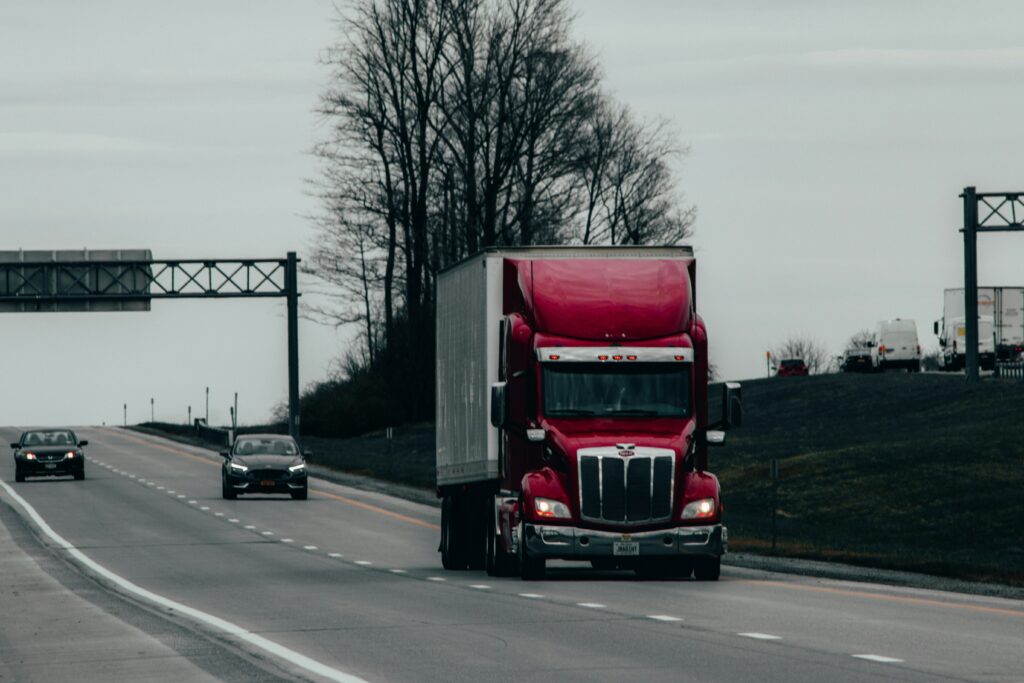
FTL, or Full Truckload, dedicates an entire trailer to one shipper’s cargo rather than splitting it across multiple shippers the way LTL does. There is no freight classification, no shared customs exposure, and typically faster, simpler transit. What FTL pricing does carry, often invisibly, is dead miles: the empty distance a carrier must drive to reach the pickup location, which gets priced into the rate before the first mile of actual cargo movement begins, a cost structure tracked by bodies such as the U.S. Department of Transportation.
What FTL – Full Truckload actually provides
An FTL shipper books the capacity of an entire trailer rather than the space their freight happens to fill, which is why some shippers run FTL even when their cargo only fills half the trailer.
- No other shippers’ cargo in the same trailer, eliminating shared customs exposure and shared handling risk.
- No freight class calculation, since FTL pricing is based on the lane and distance rather than density and classification codes as in LTL.
- Typically faster transit, since the driver goes directly from pickup to delivery without the multi-terminal relay that LTL uses.
The dead miles cost most shippers never see on the invoice
Dead miles, also called deadhead, are the empty miles a carrier drives to reach a pickup location. When a facility sits far from major freight corridors where trucks are already running loaded, that positioning cost does not appear as a separate line item. It gets absorbed into the quoted rate before any cargo has moved at all.
- A facility in a high-density freight corridor attracts carriers already nearby and rarely pays a dead-mile premium.
- A facility in an imbalanced lane, where outbound freight is plentiful but inbound loads are scarce, means carriers often charge more on the outbound move to recover the expected empty return trip.
- Rates for dry van FTL commonly run $1.50 to $3.50 per loaded mile, according to industry data compiled by the American Transportation Research Institute, and dead miles can push the effective cost per cargo mile meaningfully above that range.
Spot rate volatility and the contract vs. spot question
FTL pricing splits between contract rates, agreed in advance for recurring lanes, and spot rates, quoted fresh for each individual load.
- Spot rates fluctuate daily, responding to driver availability, weather, seasonal demand peaks, and regional capacity imbalances.
- During tight capacity periods, spot rates can run dramatically above what a contract shipper pays on the same lane, sometimes two or three times higher on short notice.
- A shipper with no contract on a lane who needs FTL urgently often absorbs the full spot premium, with no fallback to a scheduled alternative the way air-based options provide.
Where FTL – Full Truckload genuinely wins
- Large volume shipments where the cubic or weight capacity of a full trailer is actually needed.
- Cargo that cannot tolerate the multi-terminal handling of LTL, where a sealed, dedicated trailer reduces damage risk.
- Recurring, contract lanes with balanced freight flows in both directions, where predictable pricing and dedicated capacity are genuinely available.
Where an onboard courier avoids the road entirely
For a small, high-value, or genuinely time-critical shipment, FTL – Full Truckload introduces dead miles, spot rate uncertainty, hours-of-service limits already covered on this site, and weather exposure on the road, all of which a scheduled commercial flight sidesteps completely. An onboard courier does not pay dead miles, does not wait for a driver to become available in the right location, and is not subject to road capacity imbalances that push spot rates unpredictably.
FTL – Full Truckload vs. onboard courier
| Criteria | FTL – Full Truckload | Onboard courier |
|---|---|---|
| Capacity | Entire trailer, sealed, no other shippers | Accompanied baggage on a scheduled flight |
| Pricing variable | Dead miles, lane balance, spot rate swings | Per mission, no lane imbalance factor |
| Best for | Large, contract-lane, recurring shipments | Small, time-critical, or high-value shipments |
| Typical cost | $1.50–$3.50 per loaded mile, plus premiums | Higher per unit, but no dead mile or spot premium |
How OBC ONE handles a shipment that outgrows FTL – Full Truckload
A typical mission runs through six steps with OBC ONE, most of which overlap to save time.
- Brief and quote. You share the shipment, origin, destination, and the deadline. OBC ONE returns an all-in quote in under 15 minutes.
- No lane imbalance factor. The quote reflects the mission, not whether trucks happen to be scarce on that corridor today.
- Courier assignment. A vetted courier near the origin is dispatched immediately.
- Personal custody in transit. The courier carries the shipment in the cabin, staying with it through every connection.
- Direct delivery. Handover happens with the named recipient, not a terminal or dock.
- Proof of delivery. Timestamped confirmation for your records.
Why freight forwarders route these decisions through OBC ONE
Choosing the right option when spot rate uncertainty is not acceptable starts with the business model. Many specialty couriers sell directly to shippers, which puts them in competition with the forwarders who might otherwise use them. OBC ONE is built the opposite way: we work exclusively for and with freight forwarders and time-critical desks. We never approach your clients directly and never compete with you.
That partner model is backed by real operator experience. OBC ONE was founded by an onboard courier who personally flew roughly three million kilometers over six years, so the network understands exactly when FTL – Full Truckload is the right call and when a scheduled flight removes variables the road cannot. Forwarders use us because we deliver:
- An all-in quote in under 15 minutes, 24/7/365.
- 1,500+ vetted couriers positioned around major hubs worldwide.
- True door to door coverage, with import and export customs clearance and Importer of Record service in most markets.
- IATA certified dangerous goods capability for shipments that require it.
- One specialty, onboard courier and hand carry for time-critical missions, done at the highest standard.
How to choose between FTL – Full Truckload and an onboard courier
- Honest assessment of the real rate including dead miles and lane balance, not just the headline per-mile figure.
- Real network density near major hubs, so a scheduled onboard courier option is not delayed by a courier being flown in first.
- Fast, transparent quoting, ideally with a named dispatcher accountable for the mission.
- Documented dangerous goods competence, relevant to either option.
- A forwarder-only model, if you are a forwarder, so your partner never becomes a competitor for your clients.
Frequently asked questions
What is FTL – Full Truckload?
FTL, or Full Truckload, dedicates an entire trailer to one shipper’s cargo, priced per lane or per mile rather than by freight class, with no other shippers’ goods sharing the space.
What are dead miles and why do they matter?
Dead miles are the empty miles a carrier drives to reach a pickup location. When a facility sits far from active freight corridors, carriers build that positioning cost into the quoted rate before any cargo moves.
What is the difference between spot rates and contract rates in FTL?
Contract rates are agreed in advance for recurring lanes and provide pricing stability. Spot rates are quoted per individual load and fluctuate daily, sometimes running dramatically higher during tight capacity periods.
When is FTL – Full Truckload the better choice over LTL?
For large volume shipments, cargo that cannot tolerate multi-terminal handling, or recurring contract lanes with balanced freight flows, FTL typically offers simpler pricing, faster transit, and reduced damage risk.
When does an onboard courier make more sense than FTL?
For small, high-value, or genuinely time-critical shipments where dead miles, driver availability, hours-of-service limits, and spot rate volatility on the road are variables the deadline cannot absorb.
Do you sell directly to shippers or buyers?
No. OBC ONE works exclusively with and for freight forwarders and time-critical desks. We act as a white label partner and never approach our clients’ customers directly.
Get a quote without the dead mile factor in 15 minutes
If you are a freight forwarder whose deadline cannot absorb lane imbalance or spot rate uncertainty, OBC ONE gives you a straight answer, 24/7, worldwide and never a competitor. Contact our team for an all-in quote in under 15 minutes, or explore more time-critical logistics insights.