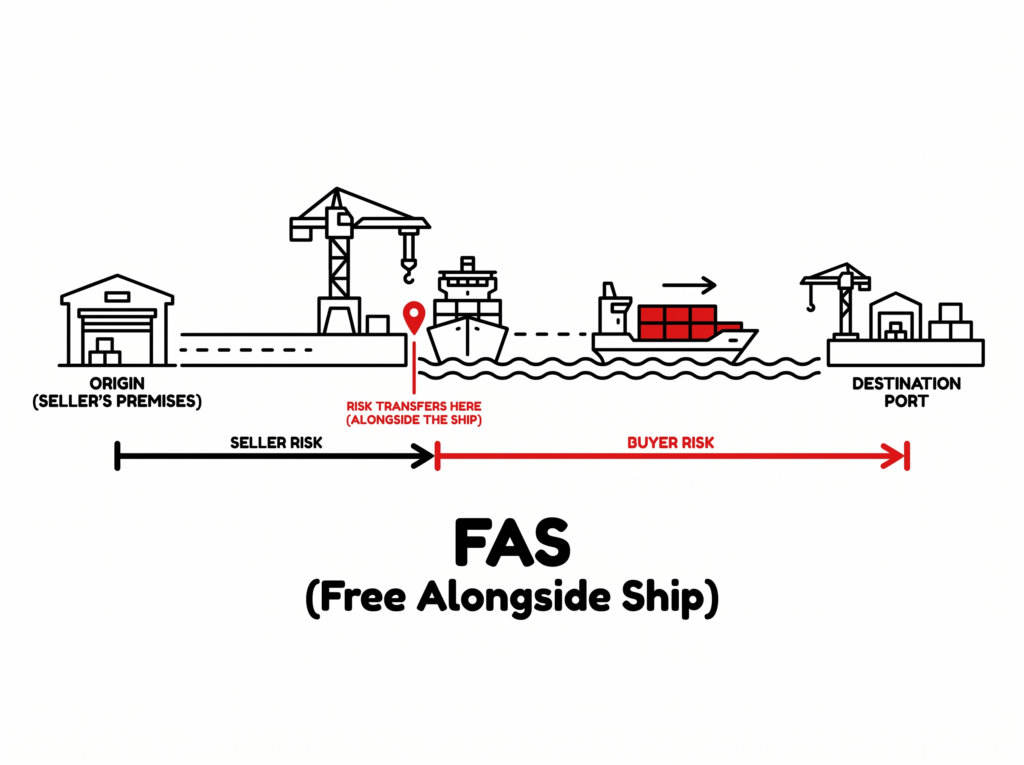
FAS, Free Alongside Ship, is an Incoterms 2020 rule used only for sea and inland waterway transport, where the seller delivers goods alongside a vessel at the named port and risk transfers there, before loading. It is built for bulk and breakbulk cargo such as grain, oil, ore, and oversize project freight, none of which will ever move by onboard courier. The genuine connection to this series is narrower: the certificates that gate a bulk shipment, an analysis certificate or a certificate of origin, are exactly the kind of small, urgent document an onboard courier is built to carry.
What the FAS Incoterm actually covers
Under the FAS Incoterm, the seller clears the goods for export and delivers them alongside a vessel nominated by the buyer, at a quay, wharf, or barge, at the named port of shipment. Risk and cost transfer to the buyer at that point, before the goods are loaded, which is the key difference from FOB.
This rule exists for cargo that is loaded directly onto a vessel rather than handed over at a container terminal. In practice, that means bulk commodities such as oil, grain, ore, and cement, or oversize and out-of-gauge project cargo too large for a standard container.
Why this rule is genuinely not an onboard courier fit
It is worth being direct about this. A cargo of bulk grain or a shipment of oversize machinery moving under FAS will never travel as an onboard courier mission. The volumes, weights, and handling requirements involved are entirely outside what a courier can carry in the cabin of a commercial flight.
- Bulk commodities such as oil, grain and ore move by the thousands of tons, not by hand.
- Breakbulk and oversize cargo often requires cranes and specialized rigging simply to reach the vessel’s side.
- Container shipments do not use FAS at all, since containerized cargo is handled at a terminal, where FCA is the correct rule instead.
Where the real connection to onboard courier sits
The cargo itself is never the fit. The paperwork that accompanies it sometimes is. A bulk shipment under the FAS Incoterm often depends on specific documents arriving at the port before the vessel’s loading window closes.
- Certificates of origin, required by the buyer’s country and sometimes issued by a chamber of commerce or trade body that is not physically at the port.
- Analysis or quality certificates, confirming the specification of a bulk commodity such as grain moisture content or ore purity, often produced by a lab some distance from the loading port.
- Missing or late documentation can hold up loading entirely, and a bulk vessel sitting idle at a port costs far more per day than the cost of getting one certificate there fast.
This is the one place an onboard courier genuinely belongs in an FAS transaction: not moving the cargo, but moving the single document that determines whether the cargo can load on schedule. The International Trade Administration publishes further guidance on Incoterms selection for exporters handling bulk shipments.
FAS vs. FOB vs. FCA
These three rules are often confused, and choosing the wrong one for the cargo type is a common, avoidable mistake.
| Criteria | FAS | FOB | FCA |
|---|---|---|---|
| Transport modes | Sea and inland waterway only | Sea and inland waterway only | Any mode, including air and courier |
| Delivery point | Alongside the vessel | Loaded on board the vessel | Named place, seller’s premises or a terminal |
| Best suited for | Bulk or breakbulk cargo loaded directly at the ship’s side | Bulk cargo the seller loads on board | Containerized cargo and any non-bulk shipment |
If the cargo is containerized in any way, FAS is the wrong choice regardless of how the contract is negotiated. FCA, already covered elsewhere in this series, is built for exactly that case.
How OBC ONE supports the documentation side of an FAS shipment
A typical certificate delivery for an FAS shipment runs through six steps with OBC ONE, most of which overlap to save time.
- Brief and quote. You share the document type, the issuing location, the port deadline and the vessel’s loading window. OBC ONE returns an all-in quote in under 15 minutes.
- Courier assignment. A vetted courier near the issuing lab, chamber of commerce or certification body is dispatched.
- Secure pickup. The courier collects the certificate directly from the issuing party.
- Personal custody in transit. The document travels with the courier the entire way, with no separate handoffs.
- Direct delivery to the port. Handover happens at the terminal office or directly to the party who needs it before loading.
- Proof of delivery. Timestamped confirmation, useful evidence if the loading schedule is ever disputed.
Why freight forwarders route these documents through OBC ONE
Choosing the right partner for an urgent certificate starts with the business model. Many specialty couriers sell directly to shippers, which puts them in competition with the forwarders who might otherwise use them. OBC ONE is built the opposite way: we work exclusively for and with freight forwarders and time-critical desks. We never approach your clients directly and never compete with you.
That partner model is backed by real operator experience. OBC ONE was founded by an onboard courier who personally flew roughly three million kilometers over six years, so the network understands what a genuinely deadline critical document run requires. Forwarders use us because we deliver:
- An all-in quote in under 15 minutes, 24/7/365.
- 1,500+ vetted couriers positioned around major hubs worldwide, including near major port cities.
- True door to door coverage, with import and export customs clearance and Importer of Record service in most markets.
- IATA certified dangerous goods capability for shipments that require it, alongside document specific missions.
- One specialty, onboard courier and hand carry for time-critical missions, done at the highest standard.
How to choose a partner for an urgent bulk shipment certificate
- Real network density near labs, chambers of commerce and certification bodies, not just port cities.
- Genuine familiarity with laycan and loading window pressure, so the mission is treated with real urgency.
- Fast, transparent quoting, ideally with a named dispatcher accountable for the mission.
- Direct delivery to the port or terminal office, not just a generic address.
- A forwarder-only model, if you are a forwarder, so your delivery partner never becomes a competitor for your clients.
Frequently asked questions
What is the FAS Incoterm?
FAS, Free Alongside Ship, is an Incoterms 2020 rule used only for sea and inland waterway transport, where the seller delivers goods alongside a vessel at the named port and risk transfers there, before loading. It is built for bulk and breakbulk cargo.
Can bulk cargo under FAS travel by onboard courier?
No. Bulk commodities and breakbulk cargo move in volumes and weights entirely outside what a courier can carry in the cabin of a commercial flight. The genuine connection is the certificates that accompany the shipment, not the cargo itself.
What is the difference between FAS and FOB?
Under FAS, risk transfers when the goods are placed alongside the vessel, before loading. Under FOB, the seller’s responsibility continues until the goods are loaded on board, and risk transfers only once the goods are on the vessel.
Why would a certificate need an onboard courier under FAS?
A missing or late certificate of origin or analysis certificate can hold up loading entirely, and a bulk vessel sitting idle at a port costs far more per day than the cost of getting one certificate there quickly. An onboard courier closes that gap.
Should FAS be used for containerized shipments?
No. Containerized cargo is handled at a terminal, not alongside a vessel, so FCA is the correct rule for containerized shipments regardless of what the contract specifies.
Do you sell directly to shippers or buyers?
No. OBC ONE works exclusively with and for freight forwarders and time-critical desks. We act as a white label partner and never approach our clients’ customers directly.
Get an urgent certificate to the port in 15 minutes
If you are a freight forwarder with a certificate that has to beat a vessel’s loading window, OBC ONE is your specialist hand carry partner, 24/7, worldwide and never a competitor. Contact our team for an all-in quote in under 15 minutes, or explore more time-critical logistics insights.