
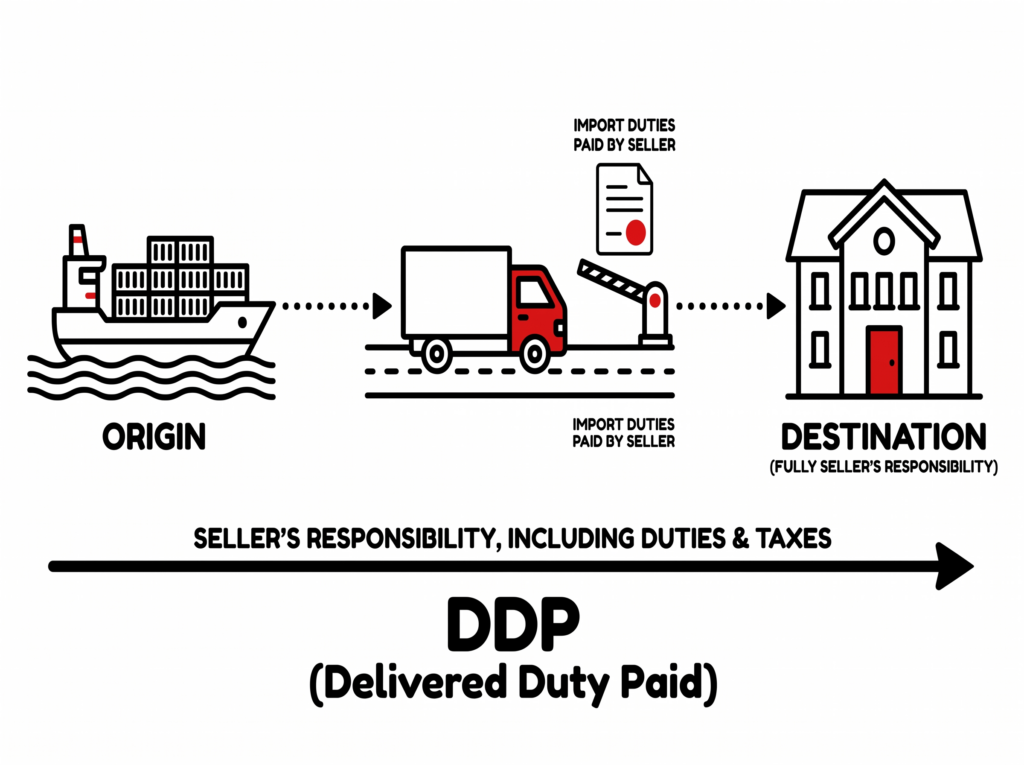
DDP, Delivered Duty Paid, is the Incoterms 2020 rule that places the maximum obligation on the seller: transport, export clearance, import clearance, duties, taxes, and delivery to the named destination, ready for unloading. The single biggest problem with the DDP Incoterm is that some countries do not allow a foreign, non-resident company to act as the importer of record at all, making DDP impossible unless the seller has a local partner who can import on their behalf.
What the DDP Incoterm asks the seller to do
The DDP Incoterm sits at the far end of the Incoterms scale from EXW. Where EXW asks almost nothing of the seller, this rule asks almost everything.
- Export clearance in the seller’s own country, the same as under DAP or DPU.
- Import clearance in the buyer’s country, the one obligation unique to this rule among all eleven Incoterms rules.
- All import duties, VAT and taxes, paid by the seller before the goods are considered delivered.
- Delivery ready for unloading at the named destination, the same delivery point used under DAP.
For the buyer, this is simple: one all-in price, no customs surprises, no broker to hire. For the seller, it is the riskiest Incoterm they can agree to.
The importer of record problem that breaks this rule
Acting as the importer of record requires a legal presence, or a registered tax status, in the destination country. Many countries simply do not permit a foreign company with no local entity to import goods in their own name.
- Some countries block it outright, requiring the seller to partner with a locally established entity before this becomes legally possible.
- VAT and GST recovery is often blocked too, since a seller who is not registered for tax in the destination country may pay import VAT they can never reclaim, a scenario the OECD has documented extensively in its cross border VAT guidance.
- Customs delays compound the risk, since the seller depends on unfamiliar procedures and an unfamiliar customs broker in a country they may have never operated in directly.
This is the single most common reason experienced trade professionals advise caution with the DDP Incoterm, not the duty cost itself, but the practical question of whether the seller is even allowed to act as importer at all.
Why an importer of record service is the actual fix
The blocker described above has a direct solution: a logistics partner who can act as importer of record on the seller’s behalf, registered and established exactly where the seller is not.
- The IOR service imports on the seller’s behalf, removing the legal presence requirement that otherwise makes this impossible in many countries.
- Duty and VAT handling moves to a party that already operates locally, instead of a seller navigating a foreign tax system for the first time.
- The seller can safely quote DDP terms to a buyer who wants one all-in price, without personally taking on import compliance they cannot execute.
This is precisely the gap OBC ONE closes, since Importer of Record service in most markets is already part of what we offer, alongside the physical delivery itself.
When DDP genuinely makes sense
- Low value shipments, such as free samples, marketing materials or product literature, where the duty exposure is small.
- First time or inexperienced buyers, who benefit from a single all-in price with no customs process to manage themselves.
- Sellers with an established local partner, such as an importer of record service, who can execute the import side reliably.
Outside these cases, most trade finance sources recommend DAP instead, which keeps the seller’s involvement to transport and leaves import clearance to the buyer.
DDP vs. DAP vs. DPU: the full D-group comparison
All three D-group rules deliver to a named destination. What changes is who does what once the goods arrive.
| Criteria | DAP | DPU | DDP |
|---|---|---|---|
| Who unloads | Buyer | Seller | Buyer |
| Who clears import customs | Buyer | Buyer | Seller |
| Who pays duties and VAT | Buyer | Buyer | Seller |
| Seller’s overall exposure | Moderate | Moderate, plus unloading | Highest of all eleven rules |
A related note for older contracts: DDU, Delivered Duty Unpaid, was retired when Incoterms 2010 replaced it with DAP. A contract that still references DDU should be treated as DAP in practice.
How OBC ONE handles this kind of mission
A typical mission under this rule runs through six steps with OBC ONE, most of which overlap to save time.
- Brief and quote. You share the origin, the named destination and the deadline. OBC ONE returns an all-in quote in under 15 minutes.
- Importer of record setup. Where needed, OBC ONE acts as importer of record, removing the legal presence blocker for the seller.
- Courier assignment. A vetted courier near the seller’s premises is dispatched to carry the shipment personally.
- Personal custody in transit. The courier carries the shipment in the cabin, staying with it through every connection.
- Import clearance and duty handling. Customs, duties and taxes are managed at destination as part of the same mission.
- Proof of delivery. Timestamped confirmation marking the point where the seller’s obligation is complete.
Why freight forwarders route DDP missions through OBC ONE
Choosing the right partner for this kind of shipment starts with the business model. Many specialty couriers sell directly to shippers, which puts them in competition with the forwarders who might otherwise use them. OBC ONE is built the opposite way: we work exclusively for and with freight forwarders and time-critical desks. We never approach your clients directly and never compete with you.
That partner model is backed by real operator experience. OBC ONE was founded by an onboard courier who personally flew roughly three million kilometers over six years, so the network understands what a genuinely full obligation mission requires. Forwarders use us because we deliver:
- An all-in quote in under 15 minutes, 24/7/365.
- 1,500+ vetted couriers positioned around major hubs worldwide, close to major factory and warehouse clusters.
- True door to door coverage, with import and export customs clearance and Importer of Record service in most markets, the exact fix this kind of mission often needs.
- IATA certified dangerous goods capability for shipments under this rule that require it.
- One specialty, onboard courier and hand carry for time-critical missions, done at the highest standard.
How to choose a partner for this kind of shipment
- Genuine importer of record capability, not just a general customs brokerage relationship.
- Real network density near major manufacturing and export hubs, so the courier can begin the mission without delay.
- Fast, transparent quoting, ideally with a named dispatcher accountable for the mission.
- Documented dangerous goods competence, where relevant to the specific shipment.
- A forwarder-only model, if you are a forwarder, so your delivery partner never becomes a competitor for your clients.
Frequently asked questions
What is the DDP Incoterm?
DDP, Delivered Duty Paid, is the Incoterms 2020 rule that places the maximum obligation on the seller, covering transport, export and import clearance, duties, taxes, and delivery to the named destination, ready for unloading.
Why is the DDP Incoterm considered risky for sellers?
The main risk is that some countries do not allow a foreign, non-resident company to act as importer of record, making DDP legally impossible without a local partner. Sellers can also face unrecoverable VAT and unfamiliar customs delays.
What is an importer of record and why does it matter for DDP?
An importer of record is the legally responsible party for importing goods into a country, which typically requires a local entity or registered tax status. An importer of record service lets a seller offer DDP terms without needing that legal presence themselves.
What is the difference between DDP and DAP?
Under DAP, the buyer handles import clearance, duties and taxes. Under the DDP Incoterm, the seller takes on all of that responsibility as well, making this the highest risk Incoterms rule for the seller.
Is DDU the same as DDP?
No. DDU, Delivered Duty Unpaid, was retired when Incoterms 2010 replaced it with DAP. A contract still referencing DDU should be treated as DAP, where the buyer handles import duties, not as DDP, where the seller does.
Do you sell directly to shippers or buyers?
No. OBC ONE works exclusively with and for freight forwarders and time-critical desks. We act as a white label partner and never approach our clients’ customers directly.
Get a quote in 15 minutes
If you are a freight forwarder structuring a shipment under this rule, OBC ONE can serve as both the courier and the importer of record, 24/7, worldwide and never a competitor. Contact our team for an all-in quote in under 15 minutes, or explore more time-critical logistics insights.