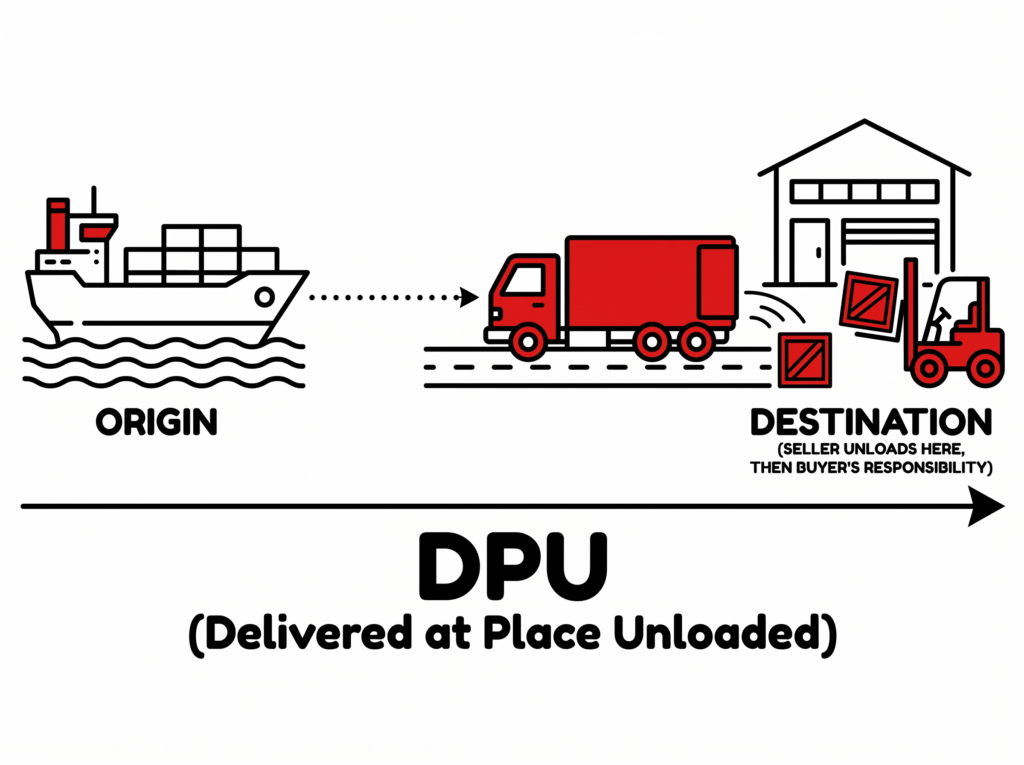
DPU, Delivered at Place Unloaded, is the only Incoterms 2020 rule that requires the seller to unload the goods at the named destination before risk transfers to the buyer. Every other obligation mirrors DAP exactly. That single unloading requirement is also what makes this rule riskier than it looks, since the seller now needs equipment, labor, or a subcontractor capable of unloading in a country they may not operate in directly.
The one obligation that separates DPU from everything else
Renamed from DAT, Delivered at Terminal, in the Incoterms 2020 revision, the current rule extends beyond terminals to any named place the parties agree on. The rename reflected a real shift: delivery no longer has to happen at a container yard or airport warehouse. It can happen at the buyer’s own site.
What did not change is the core obligation. The seller delivers, and transfers risk, only once the goods have been unloaded from the arriving transport at the named destination. Every other Incoterm, including DAP, leaves unloading to the buyer.
Why the unloading obligation is riskier than it sounds
Unloading in a foreign country is not a paperwork exercise. It requires physical capability at a location the seller often does not control.
- Equipment access, since unloading heavy or specialized cargo may require a crane, forklift or rigging crew the seller has to arrange remotely.
- Local labor and permits, which vary by country and may require coordination the seller cannot easily verify from abroad.
- Risk during unloading itself, since the seller still bears risk for any damage that occurs during this final step, not just during transit.
If the seller cannot confidently arrange unloading at the destination, most trade finance sources, including guidance from the United States Council for International Business, recommend using DAP instead and leaving unloading to the buyer, who is already on the ground there.
When DPU genuinely makes sense
Despite the added risk, there are real cases where the seller is better placed to handle unloading than the buyer.
- Capital equipment installation, where the seller’s own technicians are already traveling to install the machine and can supervise or perform the unloading as part of the same visit.
- Specialized or fragile cargo, where the seller’s familiarity with the product makes them better equipped to unload it safely than a buyer’s local team would be.
- Established seller operations at destination, where the seller already has a subcontractor or local presence capable of handling the unloading reliably.
DPU vs. DAP: the only real difference
These two rules are otherwise identical, which is exactly why the one difference matters so much.
| Criteria | DAP | DPU |
|---|---|---|
| Who unloads | Buyer, after risk has already transferred | Seller, before risk transfers |
| Risk transfer point | Goods ready for unloading at destination | Goods unloaded at destination |
| Seller’s practical exposure | Ends at arrival | Extends through the unloading process |
| Best suited for | Most standard shipments | Installation projects and specialized cargo |
Choosing the wrong one of these two rules, and specifying it in a contract without thinking through who can actually unload the goods, is a common and avoidable source of dispute.
Where an onboard courier still helps under DPU
An onboard courier cannot unload a shipping container or operate a crane, but the same custody advantage that applies across this Incoterms series still matters under DPU, particularly for the transit leg leading up to that final obligation.
- Fewer handoffs before arrival reduce the chance of damage before the seller even reaches the unloading step they are already exposed on.
- A single accountable courier can coordinate directly with the seller’s unloading team or subcontractor at destination, rather than the shipment arriving through an anonymous freight network with no one to brief in advance.
- For smaller components moving alongside larger equipment, such as tools, spare parts or documentation needed for an installation, an onboard courier can carry these separately and reliably while the main shipment moves by standard freight.
How OBC ONE supports a DPU mission
A typical DPU mission runs through six steps with OBC ONE, most of which overlap to save time.
- Brief and quote. You share the origin, the named destination, the unloading arrangement and the deadline. OBC ONE returns an all-in quote in under 15 minutes.
- Courier assignment. A vetted courier near the seller’s premises is dispatched to carry the shipment personally.
- Secure pickup. Collection happens directly from the seller, starting a single accountable custody chain.
- Personal custody in transit. The courier carries the shipment in the cabin, staying with it through every connection, with no separate handoffs.
- Coordinated arrival. Delivery is timed with the seller’s unloading arrangement at destination, so nothing waits unnecessarily once it lands.
- Proof of delivery. Timestamped confirmation, marking the point where the seller’s obligation under this rule is complete.
Why freight forwarders route these missions through OBC ONE
Choosing the right partner for a DPU shipment starts with the business model. Many specialty couriers sell directly to shippers, which puts them in competition with the forwarders who might otherwise use them. OBC ONE is built the opposite way: we work exclusively for and with freight forwarders and time-critical desks. We never approach your clients directly and never compete with you.
That partner model is backed by real operator experience. OBC ONE was founded by an onboard courier who personally flew roughly three million kilometers over six years, so the network understands what a genuinely full journey obligation requires. Forwarders use us because we deliver:
- An all-in quote in under 15 minutes, 24/7/365.
- 1,500+ vetted couriers positioned around major hubs worldwide, close to major factory and warehouse clusters.
- True door to door coverage, with import and export customs clearance and Importer of Record service in most markets.
- IATA certified dangerous goods capability for shipments that require it.
- One specialty, onboard courier and hand carry for time-critical missions, done at the highest standard.
How to choose a courier partner for a DPU shipment
- Genuine personal custody, not just a booking reference in a larger freight network.
- Willingness to coordinate directly with a seller’s unloading team or subcontractor at destination, rather than a generic address level delivery.
- Fast, transparent quoting, ideally with a named dispatcher accountable for the mission.
- Documented dangerous goods competence, where relevant to the specific shipment.
- A forwarder-only model, if you are a forwarder, so your delivery partner never becomes a competitor for your clients.
Frequently asked questions
What is the DPU Incoterm?
DPU, Delivered at Place Unloaded, is the only Incoterms 2020 rule that requires the seller to unload the goods at the named destination before risk transfers to the buyer. It replaced the earlier DAT rule and extended delivery beyond terminals to any named place.
What is the difference between DPU and DAP?
DPU and DAP are otherwise identical. Under DAP, the seller delivers the goods not unloaded, and the buyer handles unloading after risk transfers. Under DPU, the seller must unload the goods before risk transfers to the buyer.
Why did DAT become DPU?
Incoterms 2020 renamed Delivered at Terminal to Delivered at Place Unloaded to reflect that delivery no longer has to happen at a terminal such as a container yard or airport warehouse. It can happen at any named place the parties agree on, including the buyer’s own site.
When does this rule make more sense than DAP?
It makes sense when the seller is genuinely better positioned to handle unloading than the buyer, such as capital equipment installations where the seller’s own technicians are already on site, or specialized cargo the seller understands better than a local team would.
Why is the seller’s risk higher under this rule than under DAP?
The seller remains at risk through the physical act of unloading, which happens in a country they often do not operate in directly and may require equipment, labor, or permits they cannot easily verify from abroad.
Do you sell directly to shippers or buyers?
No. OBC ONE works exclusively with and for freight forwarders and time-critical desks. We act as a white label partner and never approach our clients’ customers directly.
Get a delivery quote in 15 minutes
If you are a freight forwarder structuring a DPU shipment, OBC ONE can carry it personally to the named destination, 24/7, worldwide and never a competitor. Contact our team for an all-in quote in under 15 minutes, or explore more time-critical logistics insights.