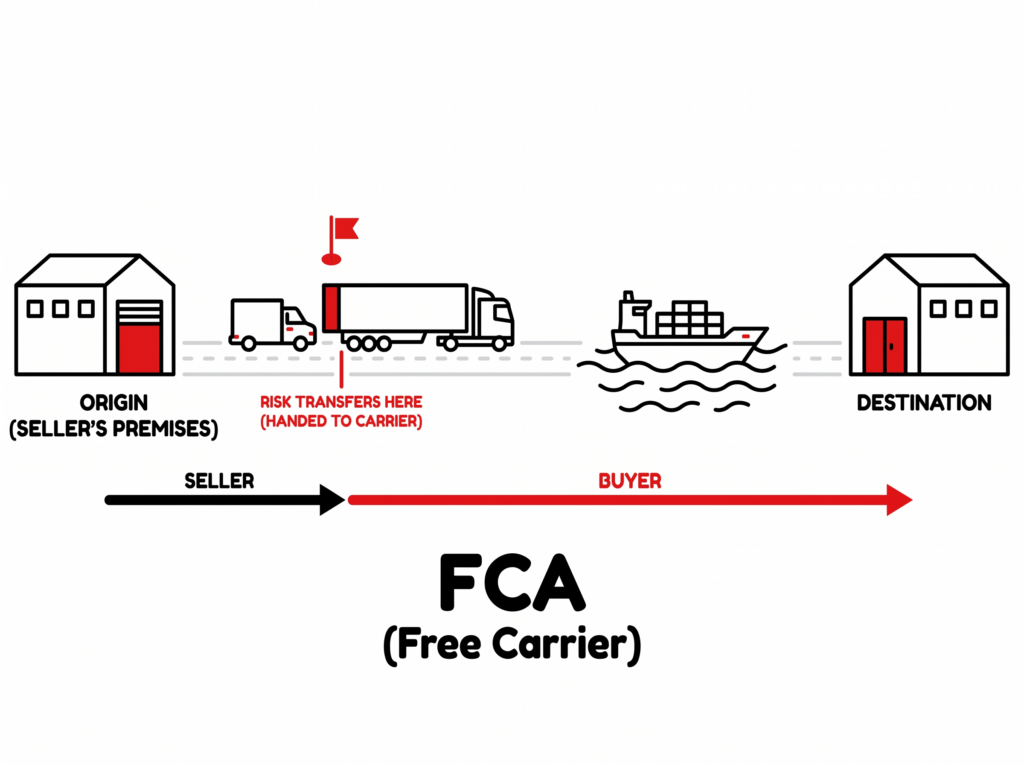
FCA, Free Carrier, is the Incoterms 2020 rule under which the seller clears the goods for export and delivers them to a carrier or place named by the buyer, at which point risk transfers. The International Chamber of Commerce recommends the FCA Incoterm over EXW for cross border trade because export clearance stays with the seller, who is actually equipped to handle it. FCA also works for every mode of transport, including onboard courier, which is exactly where the named place can be a person rather than a warehouse.
What the FCA Incoterm actually asks of each party
Under FCA, the seller clears the goods for export, bears the cost and risk up to that point, and delivers them in one of two ways. If the named place is the seller’s own premises, the seller loads the goods onto the vehicle the buyer has arranged. If the named place is somewhere else, a forwarder’s warehouse, an airport, or a container terminal, the seller delivers the goods ready for unloading, without unloading them itself. Once either handover happens, risk and further cost pass to the buyer.
This is the fix for the exact problem that makes EXW difficult across borders: export clearance stays with the party who is actually established in that country and equipped to file it correctly.
Why the named place under the FCA Incoterm has to be exact
FCA only works cleanly when the named place is specific enough to leave no room for interpretation. A city name alone is not a delivery instruction. A full street address, or a specific terminal designation, is. The precision matters because it determines exactly where risk transfers, who is responsible for loading, and what the seller’s delivery obligation actually is.
For freight forwarders drafting or reviewing shipping instructions, this single detail is worth checking on every FCA Incoterm shipment, since a vague named place is one of the most common sources of dispute after something goes wrong in transit.
The on board bill of lading fix under the FCA Incoterm
Before Incoterms 2020, FCA created a real problem for sellers being paid under a letter of credit. Banks typically require an on board bill of lading to release payment, but under FCA the seller hands the goods to the buyer’s carrier and has no direct claim on that carrier for a bill of lading. Some sellers used FOB terms instead simply to solve this documentary problem, even when FOB did not otherwise fit the shipment.
Incoterms 2020 added a specific fix: the buyer and seller can agree in the sales contract that the buyer will instruct its carrier to issue an on board bill of lading to the seller. This closes the gap without forcing an ill fitting Incoterm onto a shipment that would otherwise be a clean FCA Incoterm case.
Why the FCA Incoterm and onboard courier fit together naturally
FCA is built to work across every mode of transport, road, rail, sea, and air, including a courier travelling as a passenger. This matters because the named place under FCA can be defined as the point where the seller hands the goods directly to the courier, at the seller’s own premises.
- Export clearance is already the seller’s job, so the party actually equipped to file it correctly is doing so, with no gap for a foreign forwarder to fall into.
- The named place can be the handover to the courier, which means the goods enter personal custody immediately, without a separate pickup leg or a stop at a freight terminal.
- Risk transfer is clean and early, at a point both parties can define precisely, which suits a single, accountable courier far better than a shipment that has to first reach a generic terminal.
For a time-critical shipment where the buyer wants both fast collection and fast onward delivery, agreeing to the FCA Incoterm with the named place set at the seller’s door, handed directly to an onboard courier, is often the cleanest structure available.
FCA Incoterm vs. EXW vs. FOB
All three sit in different places on who handles export clearance and when risk transfers.
| Criteria | EXW | FCA | FOB |
|---|---|---|---|
| Export clearance | Buyer, often unworkable across borders | Seller, in their own country | Seller, in their own country |
| Risk transfer | When goods are made available, before loading | At the named place, seller’s premises or elsewhere | When goods are loaded onto the vessel |
| Transport modes | Any mode | Any mode, including air and courier | Sea and inland waterway only |
| ICC guidance | Recommended against for cross border trade | Recommended for cross border trade | Recommended only for non-containerized sea freight |
The FCA Incoterm sits in the middle deliberately: enough seller responsibility to make export clearance workable, enough buyer control to keep pricing and carrier choice flexible. In the United States, the United States Council for International Business serves as the ICC’s national affiliate and publishes guidance on applying the Incoterms rules correctly.
How OBC ONE handles an FCA Incoterm pickup
A typical FCA pickup with OBC ONE runs through six steps, most of which overlap to save time.
- Brief and quote. You share the named place, the export clearance status, destination, and the deadline. OBC ONE returns an all-in quote in under 15 minutes.
- Courier assignment. A vetted courier near the seller’s premises is dispatched to serve as the named place handover point.
- Coordinated handover. Collection happens directly from the seller once export clearance is confirmed, with no separate freight booking delay.
- Personal custody in transit. The courier carries the shipment in the cabin, staying with it through every connection.
- Import coordination. Customs clearance at destination is handled alongside delivery.
- Proof of delivery. Timestamped confirmation, and the transport documentation the buyer or seller needs for their own records.
Why freight forwarders route FCA Incoterm pickups through OBC ONE
Choosing the right partner for an FCA pickup starts with the business model. Many specialty couriers sell directly to shippers, which puts them in competition with the forwarders who might otherwise use them. OBC ONE is built the opposite way: we work exclusively for and with freight forwarders and time-critical desks. We never approach your clients directly and never compete with you.
That partner model is backed by real operator experience. OBC ONE was founded by an onboard courier who personally flew roughly three million kilometers over six years, so the network understands what a genuine named place handover requires. Forwarders use us because we deliver:
- An all-in quote in under 15 minutes, 24/7/365.
- 1,500+ vetted couriers positioned around major hubs worldwide, close to major factory and warehouse clusters.
- True door to door coverage, with import and export customs clearance and Importer of Record service in most markets.
- IATA certified dangerous goods capability for FCA shipments that require it.
- One specialty, onboard courier and hand carry for time-critical missions, done at the highest standard.
How to choose a partner for FCA Incoterm pickups
- Real network density near major manufacturing and export hubs, so a courier can serve as the named place without delay.
- Genuine familiarity with export clearance and named place precision, not just general freight knowledge.
- Fast, transparent quoting, ideally with a named dispatcher accountable for the mission.
- Documented dangerous goods competence, where relevant to the specific shipment.
- A forwarder-only model, if you are a forwarder, so your pickup partner never becomes a competitor for your clients.
Frequently asked questions
What is the FCA Incoterm?
FCA, Free Carrier, is an Incoterms 2020 rule under which the seller clears the goods for export and delivers them to a carrier or place named by the buyer, at which point risk and further cost transfer to the buyer. It works for every mode of transport.
What is the difference between FCA and EXW?
Under EXW, the buyer is responsible for export clearance, which is often unworkable when the buyer has no legal presence in the seller’s country. Under the FCA Incoterm, the seller handles export clearance in their own country, which is why the ICC recommends FCA over EXW for cross border trade.
What is the difference between FCA and FOB?
FOB only applies to sea and inland waterway transport, with risk transferring when goods are loaded onto the vessel. FCA works for any mode of transport, including air and courier, with risk transferring earlier, at the named place agreed between the parties.
Why does the named place under FCA need to be so specific?
A vague named place, such as just a city name, leaves the exact delivery obligation and risk transfer point open to dispute. A precise named place, down to the street address or terminal, removes that ambiguity.
How did Incoterms 2020 change the FCA Incoterm?
Incoterms 2020 allows the buyer and seller to agree that the buyer’s carrier will issue an on board bill of lading to the seller, solving a documentary problem that previously led some sellers to use FOB terms instead of FCA purely to satisfy a letter of credit requirement.
Do you sell directly to shippers or buyers?
No. OBC ONE works exclusively with and for freight forwarders and time-critical desks. We act as a white label partner and never approach our clients’ customers directly.
Get an FCA Incoterm pickup quote in 15 minutes
If you are a freight forwarder with an FCA shipment to collect, OBC ONE is your specialist hand carry partner, 24/7, worldwide and never a competitor. Contact our team for an all-in quote in under 15 minutes, or explore more time-critical logistics insights.