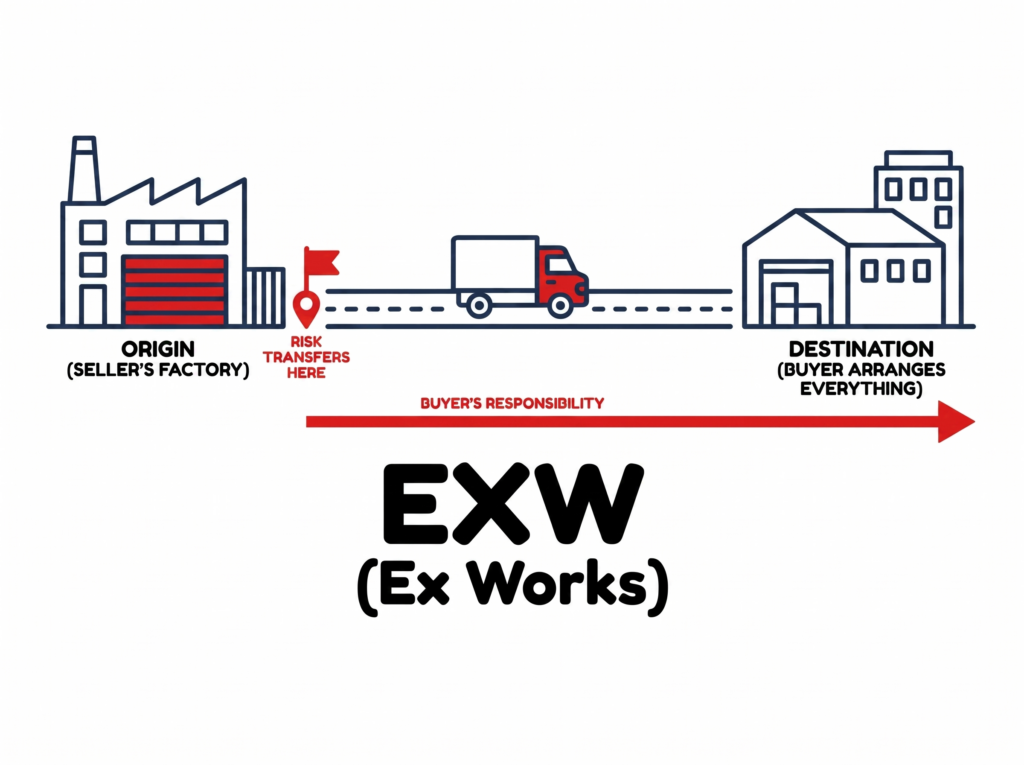
EXW, Ex Works, is the Incoterms 2020 rule under which the seller’s only obligation is to make goods available at their own premises. Everything else, loading, export clearance, freight, and import, is the buyer’s responsibility. The gap that breaks most international EXW deals is export clearance: the buyer’s forwarder often cannot legally act as exporter of record in the seller’s country, and this is usually discovered at the worst possible moment, on pickup day.
What the EXW Incoterm actually asks of each party
Under EXW, the seller’s obligation ends the moment goods are made available at a named location, almost always a factory or warehouse. The seller does not need to load the truck, does not clear export, and bears no risk once that notice is given. The buyer takes on loading, inland transport, export clearance, international freight, import clearance, and final delivery, along with every cost and risk attached to each of those steps.
On paper, this makes the EXW Incoterm look like the cleanest, simplest term available. In practice, it concentrates almost the entire operational and compliance burden on one party, and that party is frequently not equipped to carry it.
The exporter of record problem, where the EXW Incoterm actually breaks
In most countries, whoever is declared as the exporter on customs paperwork must be legally established in that country, or must appoint a licensed local agent to file on their behalf. Under EXW, that responsibility sits with the buyer, not the seller.
A buyer in Germany purchasing from a factory in Vietnam cannot simply instruct their German forwarder to clear Vietnamese export customs. The German forwarder has no license and no legal presence in Vietnam. If the buyer has not already arranged a licensed Vietnamese agent, the discovery usually happens exactly when a courier arrives at the factory to collect the goods, with export clearance impossible to complete on the spot.
The International Chamber of Commerce, which publishes the Incoterms rules, explicitly recommends FCA instead of EXW whenever goods cross a border, precisely because of this exporter of record gap. Under FCA, the seller remains the exporter in their own country, where they can actually file the paperwork.
Why the EXW Incoterm does not shield the seller either
Sellers often choose EXW believing it removes their compliance exposure. In the United States, this is not fully true. Under the Foreign Trade Regulations, a seller can still be identified as the U.S. Principal Party in Interest even under EXW terms, and remains exposed if the buyer’s agent files export data incorrectly. Sellers relying entirely on a buyer’s forwarder to get the filing right are trusting a party they do not control with their own legal risk.
When an EXW pickup becomes an onboard courier mission
Most EXW shipments move on standard timelines and never need anything beyond normal freight. The moments that turn into a genuine emergency usually follow the same pattern.
- Late discovery of the exporter of record gap, where the buyer’s forwarder only learns on pickup day that a local export agent was never appointed.
- A licensed agent found at the last minute, compressing what should have been a planned pickup into a same day scramble.
- A high value or urgent EXW purchase, such as a critical spare part bought Ex Works, where the buyer needs both fast collection from the seller’s premises and fast onward delivery, bundled into one accountable mission.
In each of these cases, an onboard courier can collect directly from the seller’s premises the moment clearance is resolved, then carry the shipment personally to its destination, recovering time the standard EXW process has already lost.
EXW Incoterm vs. FCA: what actually changes
The two terms are close in practice but differ in exactly the place that matters most for cross border trade.
| Criteria | EXW | FCA |
|---|---|---|
| Export clearance | Buyer’s responsibility, often not achievable without a local agent | Seller’s responsibility, filed in their own country |
| Loading at origin | Buyer’s responsibility, risk stays with the buyer even if the seller assists | Seller loads the goods onto the buyer’s nominated carrier |
| Risk transfer | When goods are made available, before loading | When goods are loaded, or handed to the carrier at the named place |
| Best suited for | Domestic trade or buyers with a fully capable agent at origin | International trade, including all air freight shipments |
The EXW Incoterm is not a bad one. It is a specialist term that only works cleanly when the buyer already has a trusted, licensed partner on the ground at origin.
How OBC ONE handles an EXW Incoterm rescue mission
A typical EXW rescue mission with OBC ONE runs through six steps, most of which overlap to save time.
- Brief and quote. You share the pickup location, the export clearance status, destination, and the deadline. OBC ONE returns an all-in quote in under 15 minutes.
- Courier assignment. A vetted courier near the seller’s premises is dispatched immediately.
- Coordinated pickup. Collection is timed to the moment export clearance is confirmed, not delayed further by a separate freight booking process.
- Personal custody in transit. The courier carries the shipment in the cabin, staying with it through every connection.
- Import coordination. Customs clearance at destination is handled alongside delivery.
- Proof of delivery. Timestamped confirmation for your records.
Why freight forwarders route EXW rescue missions through OBC ONE
Choosing the right partner for an EXW rescue starts with the business model. Many specialty couriers sell directly to shippers, which puts them in competition with the forwarders who might otherwise use them. OBC ONE is built the opposite way: we work exclusively for and with freight forwarders and time-critical desks. We never approach your clients directly and never compete with you.
That partner model is backed by real operator experience. OBC ONE was founded by an onboard courier who personally flew roughly three million kilometers over six years, so the network understands what a genuine last minute pickup requires. Forwarders use us because we deliver:
- An all-in quote in under 15 minutes, 24/7/365.
- 1,500+ vetted couriers positioned around major hubs worldwide, close to major factory and warehouse clusters.
- True door to door coverage, with import and export customs clearance and Importer of Record service in most markets.
- IATA certified dangerous goods capability for time-critical EXW purchases that require it.
- One specialty, onboard courier and hand carry for time-critical missions, done at the highest standard.
How to choose a partner for EXW pickups
- Real network density near major manufacturing and export hubs, so a courier is not being flown in before the mission can start.
- Genuine familiarity with exporter of record requirements, not just general freight knowledge.
- Fast, transparent quoting, ideally with a named dispatcher accountable for the mission.
- Documented dangerous goods competence, where relevant to the specific purchase.
- A forwarder-only model, if you are a forwarder, so your rescue partner never becomes a competitor for your clients.
Frequently asked questions
What is the EXW Incoterm?
EXW, Ex Works, is an Incoterms 2020 rule under which the seller’s only obligation is to make goods available at their own premises, typically a factory or warehouse. The buyer takes on loading, export clearance, international freight, import clearance, and final delivery.
Why does EXW cause problems for international shipments?
Export clearance is entirely the buyer’s responsibility under EXW, but in most countries the exporter of record must be legally established there or represented by a licensed local agent. A foreign buyer’s forwarder frequently cannot legally file export customs in the seller’s country, and this is often discovered only on pickup day.
What is the difference between EXW and FCA?
Under EXW, the buyer is responsible for export clearance and loading, and risk transfers when goods are made available, before loading. Under FCA, the seller handles export clearance in their own country and loads the goods onto the buyer’s nominated carrier, with risk transferring at loading or handover.
Does EXW protect the seller from compliance risk?
Not entirely, at least in the United States. A seller can still be identified as the U.S. Principal Party in Interest even under EXW terms, and remains exposed if the buyer’s agent files export data incorrectly, since the seller is trusting a party they do not control with their own legal risk.
When does an EXW pickup need an onboard courier?
An onboard courier becomes the right tool when export clearance is resolved late, when a licensed agent is found at the last minute, or when a high value or urgent purchase needs both fast collection from the seller’s premises and fast onward delivery bundled into one accountable mission.
Do you sell directly to shippers or buyers?
No. OBC ONE works exclusively with and for freight forwarders and time-critical desks. We act as a white label partner and never approach our clients’ customers directly.
Get an EXW Incoterm rescue quote in 15 minutes
If you are a freight forwarder with an EXW pickup at risk, OBC ONE is your specialist hand carry partner, 24/7, worldwide and never a competitor. Contact our team for an all-in quote in under 15 minutes, or explore more time-critical logistics insights.