
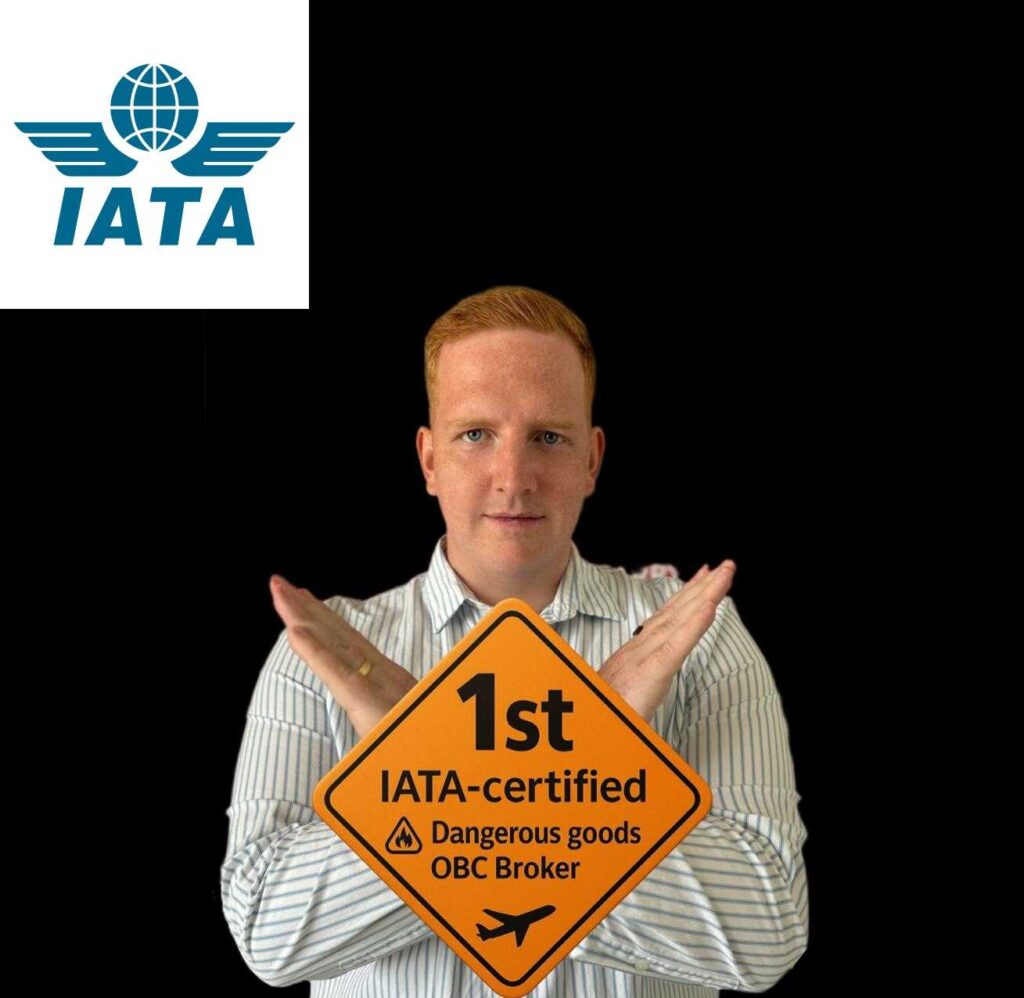
It’s official: OBC ONE and ATP Training have set a new industry benchmark: OBC ONE is now the first on board courier (OBC) broker worldwide with an IATA-certified Dangerous Goods training program specifically tailored for the OBC sector.
At OBC ONE, we don’t just move critical shipments – we move the standards of an entire industry.
This month marks a major milestone: our entire operations team has completed a Dangerous Goods training course specifically tailored to on board courier (OBC) operations and certified by IATA.
With this achievement, OBC ONE becomes the first OBC broker globally to complete such a program – built by OBC professionals, for OBC professionals.
Why this matters
In the traditional air cargo world, IATA Dangerous Goods certification is a given.
But the on board courier sector – despite its high-pressure, high-stakes nature – has long lacked a dedicated training solution.
As a result, many OBC providers rely on fragmented knowledge, slow response times, or even guesswork when it comes to handling Dangerous Goods (DG).
Not anymore.
To solve this gap, we co-developed with ATP Training, this uniquely designed program, which ensures the OBC ONE operations team can quickly assess DG shipments within the OBC scope and stay compliant with IATA/ICAO regulations.
“In emergency logistics, we need to make split-second decisions. And knowing exactly what can and can’t fly – especially when Dangerous Goods are involved – gives our clients a massive advantage,”
– Jonathan Kolb, Founder of OBC ONE
What the training covers
The training, fully aligned with IATA’s Dangerous Goods Training Guidance (DGTG) under Section 7.2, empowers our operations team to:
- Instantly assess whether a shipment qualifies as Dangerous Goods and can be transported via OBC
- Communicate confidently with airlines and customs authorities about DG classifications
- Maintain full compliance with IATA and ICAO rules – without sacrificing speed
- Make informed decisions – not risky guesses – under time pressure
This goes beyond checklists or generic modules.
Every part of the training was tailored to real-world OBC scenarios: high-stress, high-urgency situations where clarity and speed must go hand in hand.
Why clients care
Our clients – whether they’re managing an Aircraft on Ground (AOG), shipping critical medical goods, or delivering prototypes on a deadline – choose us for one reason: reliability under pressure.
When a shipment involves substances like lithium batteries, dry ice, or any other restricted goods, we don’t leave it to chance.
We know the rules, and we know how to act fast.
“Guessing is not an option. With this training, our team can evaluate complex scenarios in seconds – and that’s what keeps supply chains running.”
– Kolb adds.
What makes this different?
Plenty of air freight companies claim Dangerous Goods expertise – and rightly so.
But this is the first IATA-certified training course developed specifically for the OBC sector.
It was co-designed by OBC ONE and ATP Training to reflect the realities of our industry:
- Unpredictable pickup locations
- Complex customs procedures
- Hand carry across borders
- No time for slow decisions
This isn’t something we did to check a box. This is a foundational shift in how we operate.
Setting a new benchmark in the OBC industry
For our clients, this certification represents peace of mind.
It means every OBC ONE shipment is backed by expert knowledge and legal compliance – even when the clock is ticking.
It also shows that OBC ONE is serious about leading the way in time-critical logistics.
While others talk about “speed” or “flexibility,” we invest in precision, education, and process clarity.
This isn’t just a win for our team – it’s a win for our partners, clients, and the entire hand carry logistics community.